
AI agent development · Singapore
AI agent development in Singapore
We design, build and run custom AI agents for Singapore businesses: agents that carry out a real multi-step workflow in your own systems, on Claude or OpenAI models, with a person approving anything that matters. Every agent is scored against your current manual process before it goes live, and the build is costed in SGD before it starts.
Buying for a Malaysian team? AI agent development in Malaysia
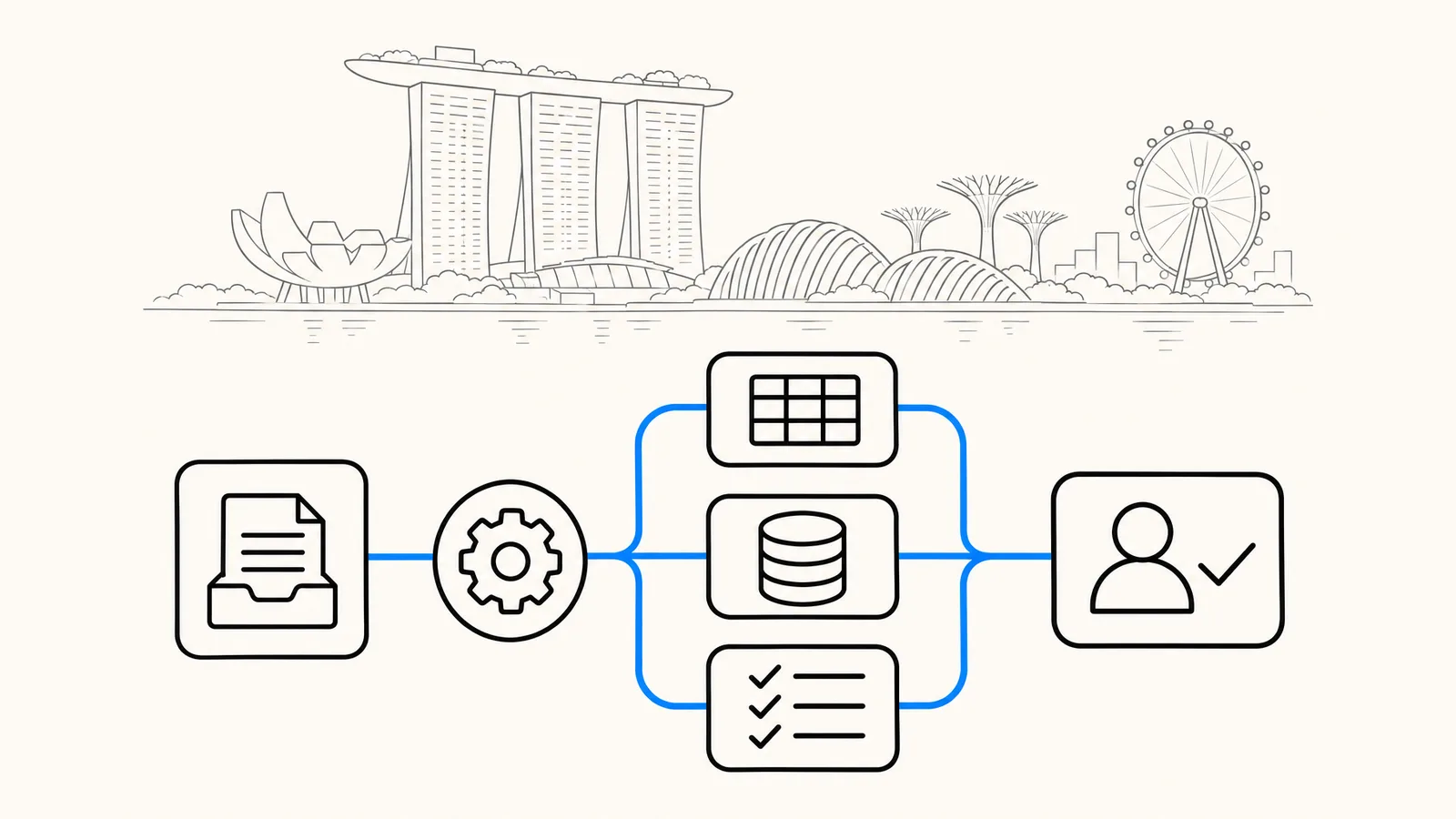
What you get from an AI agent build
An agent for one real workflow
Not a chatbot bolted onto your website. An agent that reads the documents, checks them against your rules, updates your systems and hands a person only the cases that need judgement.
Wired into your systems
Connected to the tools you already run, such as your ERP, CRM, accounting system, document store or helpdesk, through APIs and the Model Context Protocol (MCP), with least-privilege access.
A person stays in charge
Results are checked against acceptance criteria, exceptions go to a named person instead of being pushed through, high-stakes actions can require explicit approval, and every step lands in an audit trail.
Scored before it ships
We measure your manual process first, then the agent against it. If the agent does not beat the process it would replace, it does not go live, and we tell you why.
Your first weeks with us
- 01
Pick one workflow
A short discovery to choose a single, well-scoped workflow with a clear owner, such as invoice matching, claims checks or support triage. We do not start with a company-wide AI programme.
- 02
Map it and score the baseline
We sit with the people who do the work today, map every step and exception, and score the manual process on time per case, error rate, correction cost and escalation quality.
- 03
Design the agent
We decide what the agent may read, what it may change, where a person must approve, and which model fits the task. You get a fixed scope and an SGD estimate for the build and for running costs.
- 04
Build and test on your data
A proof of concept on your real documents and systems, with guardrails built in from the first version. We grade it against the baseline before it touches a customer or a ledger.
- 05
Go live, then run it
A controlled rollout with monitoring for accuracy and drift. You can keep running it yourselves, with training for the staff who review its work, or ask us to run it for you.
What does an AI agent development company in Singapore actually do?
It turns a manual, multi-step process into software that can read, decide and act inside your own systems, while a person keeps control of the decisions that carry risk. In practice that means three jobs. First, workflow design: working out which steps an agent should take, which should stay with your team, and whether an agent is needed at all. Second, building the agent: the model, the prompts, the connections to your systems, the guardrails and the tests. Third, running it afterwards: monitoring accuracy, catching drift as your data changes, and improving it. An AI agent is not ordinary software. It is probabilistic, its behaviour can shift as your inputs change, and it needs evaluation rather than only testing. That is the part most first projects underestimate, and it is the part we build in from the first week.
AI agent or simple automation? The honest first question
Many workflows that arrive as an AI agent request turn out to need a scheduled data sync, a form or a fixed rule, not an agent. We would rather tell you that in the first week than after the build. An agent earns its place when the work involves reading unstructured documents or messages, judging them against rules, and acting across more than one system. If your need is covered by a ChatGPT or Claude business plan with connectors, we will say so and help you start there instead. If scoring your process shows it already runs with very few errors, or the source data is not good enough yet, the honest answer can be not to build.
- Good fit: matching documents against each other, checking claims or applications against a policy, triaging tickets and emails, answering staff questions from your own documents
- Usually not an agent: moving the same fields between two systems on a schedule, or a fixed approval rule with no judgement in it
- Not yet: a process with no clear owner, or one whose source data is missing or unreliable
What we build: custom AI agents for real workflows
We publish worked examples of the agents we design, each with the workflow, the human approval points and how the agent is evaluated. They are written for the region, so the same patterns apply to Singapore teams in finance, operations, HR and customer service.
Worked examples: the invoice matching agent, the contract review agent, the onboarding and KYC agent, the support triage agent and the internal knowledge agent.
- Finance operations: invoice matching, cash application, bank reconciliation and credit evaluation
- Document checks: contract review against your template, insurance claims against the policy, onboarding and KYC document consistency
- People operations: HR verification before an offer, and leave and shift-cover requests checked against policy
- Customer and staff questions: support triage, product enquiries and an internal knowledge agent that answers from your own documents
Built on Claude and OpenAI models
We are Certified in the Claude Partner Network and an OpenAI Select Partner, so we choose the model for the workflow rather than for a single vendor. Most of our custom agents run on Claude, built with the Claude Agent SDK and connected to your systems through the Model Context Protocol (MCP). Where your team already works in ChatGPT Business or Enterprise, or a task suits an OpenAI model better, we build on the OpenAI API instead. Where your policy requires data to stay in your own infrastructure, private open-weight models on-premise or a hybrid setup are an option. Neither partnership is exclusive, and we will say plainly when an off-the-shelf plan already does the job.
More on our Claude partner work in Singapore and our OpenAI partner services.
How we score an agent before it goes live
Before any agent is built, we score the existing manual process on four measures: time per case, error rate, correction cost and escalation quality, meaning whether the cases handed to a person were the right ones. The agent is then graded on the same four measures against your real data. It does not go live until it outscores the process it would replace. We call this Agent GPA. The same record gives you a documented baseline, a result for each version of the agent, and a named person accountable for it, which is what a regulator or an internal audit team will ask to see.
Read the full method: Agent GPA, how we score an AI agent before it ships.
Governance for Singapore: PDPC, IMDA and MAS
An AI agent in Singapore has to meet Singapore's expectations, so governance is part of the design, not a document written afterwards. We handle personal data in line with the PDPC's requirements under Singapore's Personal Data Protection Act, offer data-residency options where your policy needs them, and map the agent's autonomy and human oversight to IMDA's Model AI Governance Framework for Agentic AI. For financial institutions, we prepare the records the MAS Guidelines on AI Risk Management point towards: an entry in your AI inventory, a risk materiality assessment, testing and monitoring records, and the named owner. Treat our work as a strong starting point for your compliance team, not legal advice.
Plain-English guide: AI governance in Singapore, from the Model AI Governance Framework to MAS.
- Least-privilege access: the agent can read and change only what its job needs
- Human approval for high-stakes actions such as payments, refunds or customer commitments
- A full audit trail of every step the agent took, so a decision can be reconstructed
- Evaluation records for every version, kept alongside the baseline
How to choose an AI agent development company in Singapore
Most vendors can show a convincing demo. The questions below separate a demo from an agent you can run in production. Ask them of any company you are considering, including us.
- Will they tell you when you do not need an agent? A good partner turns some projects down or shrinks them to a simpler fix.
- Do they measure your current process first? Without a baseline, nobody can say whether the agent is an improvement.
- Where does a person approve, and who is that person? Ask to see the approval points and the exception route in the design.
- How is the agent evaluated, and what happens when it gets worse? Ask about monitoring, drift and how a new version is tested before release.
- What can the agent access? Ask for least-privilege access, separate read and write permissions, and an audit trail.
- Which models, and why? A partner tied to one vendor will fit every workflow to that vendor.
- Who runs it after go-live? Ask whether they monitor it, train your reviewers, or hand over cleanly to your team.
- Is the price fixed before the build? Ask for the build cost and the running costs separately, in SGD, before you commit.
- Can they show worked examples? Ask for real workflows with the approval points and evaluation explained, not only a slide of logos.
What an AI agent costs in Singapore
There are two parts to the cost. The first is a fixed-scope build cost for the agent itself. The second is running costs, which depend on the model, how many cases the agent handles and the infrastructure you choose. We estimate both in SGD before any build starts, after a short discovery, so there is no open-ended engagement. Ongoing support and managed operations are optional. To get a feel for model running costs for your team, use our Claude cost calculator in SGD.
Try the Claude cost calculator in SGD.
After go-live: running the agent
An agent that worked in month one can drift by month six as your documents, products and customers change. We monitor accuracy and escalations, re-run the evaluation when anything changes, and improve the agent in controlled releases. If your team prefers to run it, we train the staff who review the agent's work. If you already have an agent that has stopped behaving, we can take it over, find out why and fix it.
See our managed service in Singapore and AI agent rescue for a broken agent.
Why work with Anchor Sprint in Singapore
We are Anchor Sprint Pte. Ltd., with a Singapore office at Suntec City, backed by a delivery team that already builds and runs AI agents across the region. Our engineers include Claude Certified Architects, and the architect who designs an agent signs off its evaluation. We publish how we work, from the use-case directory to the scoring method, so you can judge the approach before you speak to us.
Start from the Anchor Sprint Singapore overview, or see how we take Claude from proof of concept to production on our Claude implementation page.
See exactly what we build
The same agentic patterns we deploy for Singapore businesses — worked through, use case by use case, and cost-modelled in SGD.
Common questions
- Which company can build a custom AI agent for my Singapore business?
- Anchor Sprint designs, builds and runs custom AI agents for Singapore businesses from our office at Suntec City. We start with one workflow, score your current process, build the agent on Claude or OpenAI models, and only put it live once it beats that baseline. Whoever you choose, ask how they evaluate the agent and where a person approves.
- What is the difference between an AI agent and a chatbot?
- A chatbot answers questions in a conversation. An AI agent carries out a task: it reads documents or messages, checks them against your rules, takes actions in your systems such as updating a record or drafting a reply, and hands the exceptions to a person. Many useful agents never talk to a customer at all.
- How long does it take to build an AI agent in Singapore?
- A proof of concept for one well-scoped workflow is usually a matter of weeks, not months. A full production rollout takes longer, mostly because of system integration, data quality and training the people who review the agent's work, not because of the AI. We give you a timeline with the fixed scope after discovery.
- How much does AI agent development cost in Singapore?
- It depends on the workflow, the systems involved and the volume of cases. We quote a fixed-scope build cost plus estimated running costs, both in SGD, before the build starts. Managed operations after go-live are optional and priced separately.
- Do you build AI agents on ChatGPT or on Claude?
- Both. We are Certified in the Claude Partner Network and an OpenAI Select Partner. Most of our custom agents run on Claude with the Claude Agent SDK and MCP; we build on the OpenAI API where your team already uses ChatGPT Business or Enterprise, or where a task suits an OpenAI model. On-premise open-weight models are an option where data must stay in your infrastructure.
- Are your AI agents aligned with PDPC and IMDA guidance?
- We design around the PDPC's requirements for personal data, offer data-residency options, and map each agent's autonomy and oversight to IMDA's Model AI Governance Framework for Agentic AI. For MAS-regulated firms we prepare the AI inventory entry, risk materiality assessment and testing records the MAS Guidelines on AI Risk Management point towards. It is a strong starting point for your compliance team, not legal advice.
- Can an AI agent connect to our existing ERP, CRM or helpdesk?
- Yes. Agents connect to the systems you already run through their APIs or the Model Context Protocol (MCP), with read and write access separated and limited to what the job needs. You do not need to replace any system to use an agent.
- What if we do not need a custom AI agent?
- Then we will tell you. Some requests are better solved by a ChatGPT or Claude business plan with connectors, a scheduled data sync or a simple rule. We would rather say that in the first week than build something you do not need.
- Who looks after the AI agent once it is live?
- Your choice. We can run it as a managed service, monitoring accuracy and drift and releasing improvements, or train your team to review its work and run it yourselves. Either way, a named person stays accountable for what the agent does.
More for Singapore
Have a workflow in mind for an AI agent?
Tell us the process and the systems it touches. We will tell you honestly whether it needs an agent, how we would score it, and what the build would cost in SGD.
Anchor Sprint Singapore
7 Temasek Boulevard, #12-07 Suntec Tower One
Singapore 038987
Fax: +65 6917 8977
Anchor Sprint Pte. Ltd. · UEN 202632732Z
Claude and Anthropic are trademarks of Anthropic, PBC. Anchor Sprint is Certified in the Claude Partner Network; this does not imply endorsement of our services. Pricing is indicative and shown in SGD; confirm current Anthropic pricing before purchase.