
Corporate communications consistency agent
We design, build and deploy an agent that takes one approved corporate message — an earnings statement, a press release, an internal memo — and produces the English, Bahasa Malaysia and Chinese versions that hold your brand voice, keep every material figure and claim identical, flag anything that drifts, and route to your comms or IR lead for sign-off — so your team stops reconciling versions and starts trusting them.
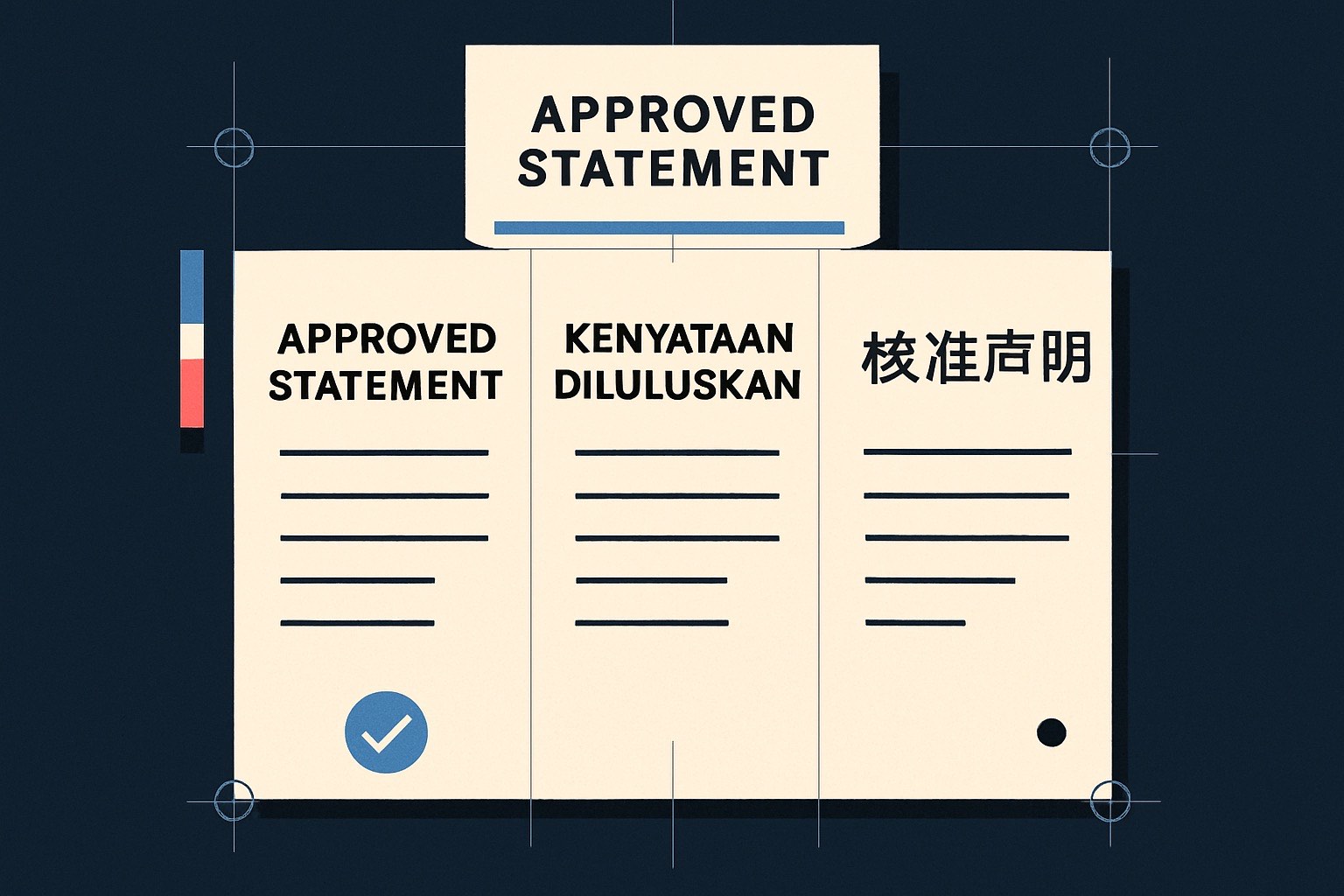
At a glance
For a listed or multi-region company, one off-brand translation or one inconsistent figure across languages is a real disclosure and reputation risk — this removes both while cutting the reconciliation grind.
An evaluator-optimizer loop — a drafter plus a consistency checker — over a single approved message; the real work is the brand-voice rubric, the figure/claim diff, and the human sign-off, not exotic infrastructure.
What changes when it works
Time per application
Localising + reconciling one announcement by hand
~half a day–a day
With the agent
~15–30 min review
Time saved
≈ hours saved on every announcement that goes out in more than one language — but the bigger win is the risk it removes: a figure that reads differently in the Chinese version, or a dividend called 'special' in one language and 'final' in another, caught before release rather than after.
Indicative; actual time depends on message length and how many languages and channels you publish to.
Our agentic development process
Every use case follows the same seven stages — from framing the problem to production.
Our process, built on Anthropic's agent guidance and the Agent GPA eval framework: Building Effective Agents · Agent GPA
Stage 1 · Frame
The business problem
A listed group or multi-region company issues the same message — quarterly results, a price change, a policy update — and it has to go out in English, Bahasa Malaysia and Chinese, to the exchange, the press and staff, often on the same day. Today that's hand-translated or run through generic machine translation, then reconciled by whoever is free. The brand voice drifts between languages, a figure or a claim gets phrased differently in one version, and for anything price-sensitive that inconsistency is a disclosure risk. The comms team spends its time proving the versions match instead of communicating.
Stage 2 · Map
The manual workflow today
- 01Approve the source message in one language
- 02Hand it to translators or run generic machine translation
- 03Read each version back for tone and accuracy
- 04Cross-check that every figure and claim matches the source
- 05Chase down and fix the drifts, under deadline
- 06Release across channels — hoping nothing slipped
Where it breaks: The bottleneck is reconciliation — proving that three language versions say exactly the same material thing, in the right voice, before a hard deadline.
Stage 3 · Design
The agentic workflow
We build it as an evaluator-optimizer loop: the agent drafts each localized version against your brand-voice guide, then a checker compares it back to the approved source — every figure, every material claim, the tone — and the drafter revises until it passes. Anything it can't resolve is flagged for a human, and nothing publishes without sign-off.
Re-drafts until every figure, claim and the brand voice pass the consistency check — otherwise it flags a human.
Watch a case flow through the agent — it does the reading and matching; a human still makes the decision.
See it in action
Source (English, approved)
Localised — checked & flagged
- BM + Chinese drafted in your brand voice
- ✓ RM 1.42b · +11% YoY · 3.5 sen — identical across all three
- ⚠ BM draft called the dividend 'istimewa' (special) — source says 'final' · flagged for a human
Nothing publishes until your IR lead signs off · every figure checked back against the approved source · ~RM 2–7 in AI cost.
Step by step
- 1
Take the approved source
The agent starts only from the message you've already approved — plus your brand-voice guide, your approved glossary, and the key facts. It never invents the source; it localizes what's signed off.
- 2
Draft in each language
It writes the English, Bahasa Malaysia and Chinese versions in your house voice — not a literal word-for-word translation, but the same message said the way your brand says it in that language.
- 3
Check every figure and claim back to source
A separate checker extracts every number, date and material claim from the source and from each draft, and diffs them. A figure that reads differently, a claim that's softened or added, a dividend labelled differently — all surfaced, not buried.
- 4
Revise until it passes
Where the check fails, the drafter revises and re-checks. It loops until every material point matches the source and the brand voice holds — or, if it can't resolve something, it stops and flags it.
- 5
Route for human sign-off
It hands your comms or IR lead the set of versions with any drift flags called out — so review is minutes on the exceptions, not a full re-read of every language.
- 6
Release, logged
Once signed off, the versions go out through your channels — and every draft, check and flag is logged, so any released version can be reconstructed and audited later.
Stage 4 · Build
How we build it with Claude
Because it drafts against your brand-voice guide and checks every version back to the approved source, it can't quietly introduce a new claim or a different number — and because a human signs off on the flags, the agent never releases anything on its own. Every version, every check and every flag is logged for audit.
Integrations
- Your brand-voice / tone-of-voice guide + approved glossary
- Your CMS, IR portal or newswire (exchange filing, press)
- Internal channels (email, intranet, Slack / Teams)
- Optional: your translation memory
Under the hood
- Pattern: an evaluator-optimizer loop on the Claude Agent SDK — a drafter and a checker, each tool exposed via an in-process MCP server.
- Context: your brand-voice guide, approved glossary and the source message are loaded each turn and prompt-cached, so drafts stay on-voice and on-terminology.
- Tools: read-only source + glossary lookups, a per-language drafter, and a consistency-checker that extracts every figure and material claim from source and draft and diffs them.
- Guardrails: it can't mark a version 'ready' until every figure and material claim matches the source; it never publishes — it routes to a human sign-off queue; least-privilege access to your CMS/newswire.
- Untrusted input: any external copy pulled in (analyst text, prior coverage) is treated as untrusted and prompt-injection resistant; personal data in staff comms handled PDPA/PDPC-aligned.
- Recovery: on an unresolved drift it stops and flags for a human — never a silent mis-statement or a version released unchecked.
- Observability: every draft, check and flag is logged and traceable, so any released version can be reconstructed and audited.
- Eval harness: a golden set of your past announcements — including the tricky, price-sensitive ones — regression-tested on every change before it touches a live release.
Stage 5 · Architect
Single model or multi-agent?
Drafting on-voice and checking for consistency are different jobs, so we split them into a drafter and a checker — but it's still one tight loop over a single approved message, not a sprawling multi-agent system.
We reserve heavy multi-agent designs (≈15× the tokens) for genuinely parallel work — a single announcement is a focused draft-and-check loop.
Which model does what
Draft the localized version on-voice
Reliable, on-brand writing across languages — not literal translation.
Check figures & claims back to source
Careful extraction and diffing of every material fact between source and draft.
Bulk glossary / terminology matching
Cheap and fast for keeping approved terms consistent across versions.
What it costs — an estimate
AI usage — per announcement
a few languages with a draft-and-check loop, at Claude token rates
~RM 2–7
AI usage — at 30 announcements/month
scales with message length and number of languages
~RM 50–220 / month
Build (one-off)
connecting your brand guide, CMS/newswire and channels is a few weeks; we quote fixed after a short discovery
scoped per integration
Ongoing
small next to a single avoided mis-disclosure or off-brand release
monitoring + support
Indicative only, shown in Ringgit at roughly RM 4.09 to the USD (mid-market, 11 Aug 2026); per-token rates follow Anthropic's published pricing (confirm current figures). Actual AI usage depends on message length and how many languages you publish. You can model the same figures in SGD or your currency with our Claude cost calculator.
Stage 6 · Evaluate
How we measure success
- Deterministic checks first — every figure in the source appears, identical, in each version
- Self-verification — the checker diffs each draft's material claims against the source before it's marked ready
- Business KPIs — reconciliation time saved, drifts caught before release, and zero inconsistent disclosures
We score the agent with the Agent GPA framework — Goal, Plan, Action, a current standard for agent reliability — on top of your human review baseline. (reference)
Setting the baseline
First we measure your current process on a sample of past announcements — how long localization and reconciliation take, and how many drifts (a figure, a claim, a tone slip) reach a human late. That baseline is what every agent metric is measured against, so the lift is provable rather than assumed.
What we test — Goal · Plan · Action
Material-claim consistency
Every figure and material claim in a version matches the approved source, on held-out announcements
Brand-voice adherence
Each version scores against your tone-of-voice rubric
No omitted disclosure
Every required section and caveat present in each language
Figure accuracy
Every number, date and percentage identical to the source
Terminology consistency
Approved glossary terms used the same way across versions
No invented claims
Never adds a statement that isn't in the approved source
The go-live gate
The agent doesn't mark a version ready for sign-off until it matches the source on every figure and material claim and clears these GPA targets on a golden set of your past announcements. A human always signs off before release.
Stage 7 · Deliver
How we'd deliver it
We start with a proof-of-concept on your real past announcements, pilot it on one message type — say internal comms — with your comms lead reviewing every version, then extend to IR and press. A focused rollout is a matter of weeks.
Free consultation
Publishing the same message in three languages?
Tell us what you publish and in which languages, and we'll tell you honestly whether a consistency agent is worth building — and what it would take.
Related use cases
Frequently asked questions
- Does it replace our translators or comms team?
- No. It does the first draft and the consistency check, and it flags what needs a human eye — your team reviews and signs off. It removes the reconciliation grind, not the judgment.
- How does it keep our brand voice?
- We load your tone-of-voice guide and a set of past approved messages, and the agent both drafts and self-checks against them. Voice is scored on every version before a human sees it — so it reads like your brand in each language, not like a translation.
- Is it safe for price-sensitive or disclosure material?
- It's built for exactly that: every figure and material claim is checked back to the approved source, nothing publishes on its own, and every version is logged for audit. It supports your disclosure process as a control — it doesn't replace your advisers' or board's judgment on what to disclose.
- Which languages does it handle?
- English, Bahasa Malaysia and Chinese out of the box, and we can add others. It also holds your approved glossary, so regulated and brand terms are translated consistently every time.
Examples are based on real, anonymised engagements; details are generalised. Anchor Sprint is Certified in the Claude Partner Network: a deployment and rollout partner, not a reseller. This is general information, not legal or compliance advice.