

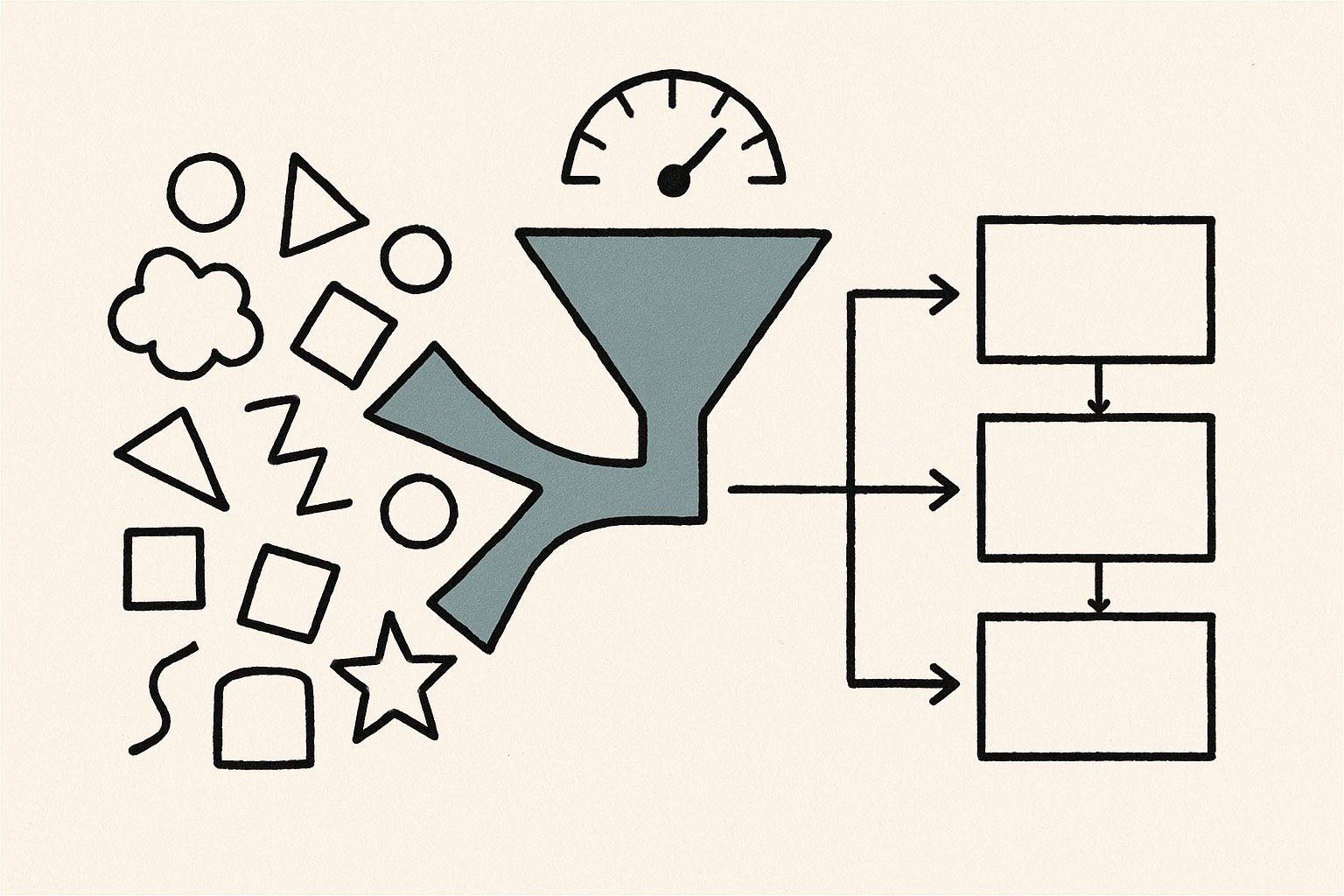
The pilot works. Everyone has watched it work. And nobody will take the human out of the loop, because nobody can tell which runs are the bad ones — so the reviewer stays, the headcount stays, and the project quietly becomes a very expensive autocomplete.
On 15 September a model vendor put a number on why. TypeSafe AI, announcing a model class called System One Models and a first model called Jev, wrote this:
"If a model can do a task 95% of the time but doesn't say when it's in the 5%, it can't automate that task."
I have been in enough rooms where a pilot stalled to recognise that sentence immediately. In our experience it is where Malaysian automation projects stop: eighty per cent built, working most of the time, with someone still checking the output by hand because no one can defend switching them off.
What TypeSafe shipped on 15 September
TypeSafe AI published System One Models and Jev, in early access. The author is the company's founder, Diogo Almeida, who says he worked at OpenAI on the instruction-following methods behind ChatGPT. The company describes two years in stealth.
Their definition: "a new class of frontier models built to make fast, structured decisions that software can use directly". Underneath sits a new architecture, a parallel sampler, and a training method they call Reinforcement Learning for Calibrated Decisions, or RLCD.
The design choice that matters is what they gave up.
Why Jev does not generate text at all
TypeSafe's first design decision is that Jev does not generate strings. At all.
"While Jev gives up string generation, it's optimized for structured outputs and can't hallucinate."
Instead of producing words your code then has to parse and validate, the possible outputs and their structure are declared in advance, and the model returns a typed value with what the company calls a calibrated probability. Their analogy is the clearest line in the piece: "a frontier-intelligence function call: unstructured state in, typed probabilistic decisions out."
The company describes the sampler as parallel rather than sequential: nothing is generated token by token, so everything comes back in a single pass. That is where the speed claims come from. TypeSafe reports end-to-end responses of 70ms–500ms against "3 to 329 seconds for frontier models", which it characterises as 40× to 200× faster on the kind of query it is built for. Its published pricing, as announced in September 2026, is USD 0.042 per million input tokens with output tokens free — "too cheap to meter".
Does "can't hallucinate" mean Jev cannot be wrong?
This phrase will travel further than the announcement, and it is narrower than it sounds.
What TypeSafe guarantees is schema conformance. The output will always be a valid value of the type you declared — the model "never makes type errors" — and the company is explicit that the figure behind that is "not empirical. Schema matching is guaranteed, thus we can confidently add 0% into the plots."
Schema conformance, if it holds as claimed, is a real guarantee. It says nothing about whether the answer is right.
This is the distinction that separates a scripted bot from an agent that decides — the subject of chatbot vs AI agent. A model that must return one of route_to_finance, route_to_support or needs_a_human will always return one of those three. It can still route a finance ticket to support. What changes is that the failure is now a wrong decision rather than a malformed one, and it arrives with a confidence score attached.
"Cannot hallucinate" means cannot hand your code garbage it can't parse. It does not mean cannot be wrong.
Six reasons to discount the numbers — from TypeSafe itself
Every figure above is the vendor measuring the vendor. What is unusual is that TypeSafe published the reasons to doubt them, unprompted:
- Published evals are "generally run from our laptops on the West Coast"
- On pricing, they "can't prove it isn't subsidized"
- The side-by-side demo used a simplified query, and "the relatively shorter input paints our model in an advantageous light"
- The workflow evals "were made by individuals on our model capabilities team, so some bias could exist"
- The LLM hallucination comparison numbers come from OpenRouter, where "there almost certainly is bias here"
- On the Wikiracing demo, "our speedups here tend to be a lot less than in previous demos" — it ran against the non-reasoning modes of the other models, except Astra, set to its lowest reasoning setting, where "the LLMs look much worse at this task than with reasoning enabled"
Even the homepage multipliers — 193.6× faster, 444.6× cheaper — carry the company's own note that "we expect that these are on the higher end of real world gains".
The company published every one of these itself, which is why the numbers are worth reading at all, and why none of them should go into your business case unadjusted.
The junctions where agents break in production
TypeSafe's use-case list contains a phrase worth borrowing: "AI-Powered Workflows / smart if-statements" — "classify, route, score, extract, or branch where hand-written logic is too brittle."
That describes the least glamorous and most valuable half of agent work. When we build an agent for a Malaysian business, the parts that break in production are almost never the clever reasoning. They are the junctions:
- Is this a duplicate supplier invoice, or a second delivery on the same PO?
- Does this returns request need a human, or can it be approved on the spot?
- Which tax category does this line item belong to?
- Is this customer about to churn?
Each one is a decision somebody used to make in two seconds and nobody ever wrote down. Each one is also where the reviewer you were trying to remove is still sitting, reading every row.
Today those junctions get answered by asking a language model and parsing what comes back. That is what we build, and it works — but at high volume the cost is real, and the confidence signal has to be engineered on top rather than arriving from the model. We build on Claude and nothing in this announcement changes that; TypeSafe's own framing puts System One models alongside language models for different shapes of task, not in place of them. Whether that confidence belongs inside the model or in the orchestration around it is the open question. Today only one of the two is something a client can put into production.
The economics they are betting on
The company is also honest about the economics. Jev is named after the economist William Stanley Jevons, and the announcement invokes the same mechanism Jevons described: every order-of-magnitude fall in the cost of intelligence opens up orders of magnitude more use cases. The bet is not about spending less. At a low enough price you start automating decisions nobody would currently pay a model to touch. TypeSafe reports its Doom-playing demo running at roughly ten queries a second for about USD 7 an hour.
What we are not recommending, and why
We have not used Jev. It is waitlisted early access, and we have not run a single one of these numbers ourselves.
So we are not recommending it, we are not migrating anything, and we would not put an early-access model with admittedly unproven pricing economics into a client's production path this month.
One practical limit is worth knowing before anyone gets excited: Jev can choose from at most 255 possible answers per call — its cardinality ceiling. If your decision is which of these 3,000 SKUs, that is a two-stage workaround, not a single call.
The interesting claim is not the speed multiplier. It is that calibration can live inside the model as well as around it. Today we build that confidence layer ourselves, in the orchestration, because that is where it can be audited and tuned per client. If a model class carries part of it natively, that changes what is worth automating — it does not change who has to decide what "confident enough" means for your invoices.
The part you can use without a waitlist
Go and find the junctions in your own process — the classify, route, score and extract decisions a person currently makes by eye. Write each one down as a question with a fixed set of answers. The exercise is free and takes an afternoon, and in our experience most teams never do it.
Then ask what your current system does when it is unsure. If the honest answer is that it returns an answer with the same confidence either way, you have found why a human is still checking every row — and you have found the thing worth fixing, whichever model you end up using. That question is also the one that decides what an agent costs to build and run here, because the review step is usually the expensive part.
Free consultation
Which decisions in your process can a model take today?
Send us one workflow. We will map the junctions, tell you which ones a model can take today and which still need a person, and be specific about where the confidence is not good enough yet.
Related reading
What an AI agent costs to build and run in Malaysia
AI agent development in Malaysia
Agent use cases, with worked examples
Source: TypeSafe AI, "Introducing System One Models & Jev", 15 September 2026, retrieved 21 September 2026.
Every performance and pricing figure in this article is the company's own, measured by the company; none has been
independently verified, and Anchor Sprint has not tested Jev.