
CTO guide · AI-assisted software development
AI SDLC: Claude Code vs Codex
Design an AI software development lifecycle with Claude Code, Codex, and agentic review tools. Compare engineering controls, advanced workflows, business value, and workflow design with Anchor Sprint.
By Anchor Sprint · Updated · For CTOs, engineering leaders, and product owners
Download the PDF reference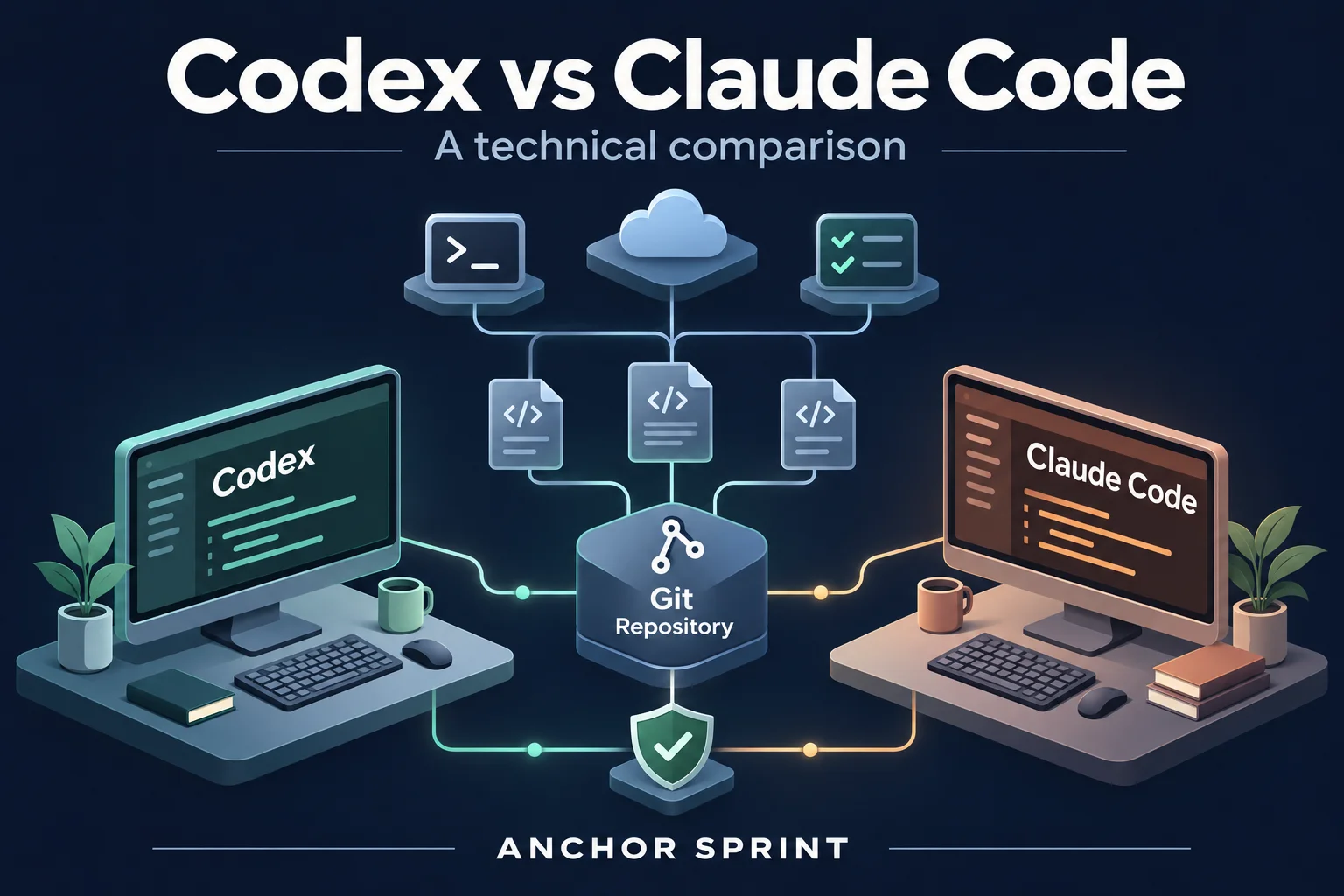
Free Anchor Sprint guide
36 pages · English PDF
Research checked 25 November 2026
Download the AI SDLC reference guide
Save the full Codex and Claude Code comparison for your team. Includes enterprise controls, detection integrations, inference routes, advanced workflows, CTO evaluation tables, and all 74 research references.
For CTOs, engineering leaders, and product owners. Research is dated; verify current product details before procurement or rollout.
Which tool should your team choose?
Use AI development tools within a defined software development lifecycle, or SDLC. Connect planning, implementation, testing, review, release, and operations to measurable outcomes. Anchor Sprint can help your team design that workflow.
Choose through a controlled trial on your repository. Both products can inspect code, edit multiple files, run commands, and use external tools. Neither has a universal technical advantage across every task.
Start with Codex if its ChatGPT access, native Windows isolation, or existing OpenAI workflows match your environment. Start with Claude Code if its deployment providers, instruction system, or Claude integrations match your requirements. These are workflow recommendations from this guide, not measured performance rankings.
Both tools support terminal use and remote tasks. A comparison that describes Codex as cloud-only or Claude Code as terminal-only is incomplete. 1 2 3 4
- For advanced users: jump to goals and workflows, then try the paired prompts and recommended rollout patterns.
- For business and product leaders: review the AI SDLC and PDLC map, business scorecard, and Anchor Sprint workflow design.
- For individual developers: compare time to an accepted change, review effort, and usage limits on your normal workload.
- For engineering teams: compare repository instructions, automation output, access policies, and reproducible development environments.
- For security teams: compare the execution host, model endpoint, credentials, network paths, and policy enforcement separately.
- For enterprise architects: compare mandatory controls, custom detection, third-party inference, and deployment acceptance tests.
Technical comparison at a glance
The table compares documented capabilities. Availability can differ by client version, account, provider, and administrator policy.
| Dimension | Codex | Claude Code |
|---|---|---|
| Local workflow | CLI and IDE extension can inspect, edit, and run repository tools. 1 | Terminal, IDE, desktop, and browser interfaces. 2 |
| Remote execution | Cloud tasks use their own workspace and can continue while your computer sleeps. 3 | Cloud sessions continue remotely; self-hosted execution is also documented. 4 |
| Model selection | Model and reasoning controls vary by surface and account. 5 | Aliases, explicit model IDs, effort settings, and provider-specific selection. 6 |
| Project guidance | AGENTS.md hierarchy, AGENTS.override.md, and configured fallback names. 7 | CLAUDE.md, scoped rules, auto memory, and conditional AGENTS.md support. 8 |
| Configuration | User and trusted project config.toml layers. 31 | Permission rules can be shared through repository settings and managed policies. 10 |
| Native Windows isolation | A native Windows sandbox is documented; compatibility and implementation matter. 12 | Native Windows shell commands are unsandboxed; use WSL2 for the built-in shell sandbox. 11 |
| Extensions | Skills, plugins, MCP connections, and lifecycle hooks. 13 15 17 | Skills, plugins, MCP connections, and lifecycle hooks. 14 16 18 |
| Parallel work | Subagents with separate work and configurable agent definitions. 19 | Custom subagents with their own context and tool access. 20 |
| Persistent goals | /goal with status, edit, pause, resume, and clear controls. 32 33 | /goal with a separate completion evaluator; supports /goal clear. 34 |
| Advanced orchestration | Combine goals, skills, subagents, SDKs, and worktrees. 19 23 42 | Dynamic workflows put agent orchestration in a rerunnable JavaScript script. 35 |
| Automation | codex exec; JSONL events and JSON Schema output. 21 | claude -p; JSON, streaming events, and JSON Schema output. 22 |
| Integration | Codex SDK; app server for custom clients. 23 | Claude Agent SDK with Python and TypeScript packages. 22 |
| Provider options | Local Codex surfaces can use OpenAI models through Amazon Bedrock. 25 | Anthropic direct and documented AWS, Google Cloud, and Microsoft provider routes. 24 |
| Billing | Plan allowance, eligible credits, or separate API-key billing. 26 | Subscription usage, usage credits, or provider/API billing. 27 28 |
CTO decision: is Codex or Claude Code right for us?
Choose a permitted operating model first. Then compare results on your own work. A feature advantage cannot compensate for an unmet data requirement, unusable build environment, or unacceptable production failure rate.
The recommendations below are conditional starting points for a pilot. They are our interpretation of documented controls, not a universal ranking of model intelligence or coding quality.
- Treat approved data handling, identity, source access, and execution boundaries as pass-or-fail requirements.
- Classify every important requirement as demonstrated, unsupported, or unknown. Resolve unknown requirements before procurement approval.
- Evaluate add-on services separately. A developer subscription does not automatically include every review, security, or approval feature.
- Keep an exit path: portable instructions, ordinary Git history, independent acceptance checks, and documented tool-specific configuration.
| Your requirement | Starting recommendation | Evidence required before committing |
|---|---|---|
| Native Windows commands with an enforced shell boundary | Pilot Codex's native Windows sandbox. Claude's built-in shell sandbox requires WSL2 on Windows. 11 12 | Run your actual Windows build tools and harmless denied-access checks. Confirm that integrations follow separate access policies. |
| Existing ChatGPT access and OpenAI development workflows | Include Codex in the first pilot, using the actual plan and model access available. 26 | Verify workspace access, included usage, approved authentication, and the cost of the representative workload. |
| Rerunnable script-based multi-agent orchestration | Evaluate Claude Code dynamic workflows alongside your Codex SDK implementation option. 23 35 | Test aggregation, failure handling, saved results, bounded agent counts, and operator recovery. Do not assume equivalent runtimes. |
| Hosted PR review plus repair and delegated approval policy | Evaluate the Claude Ship services as separate purchases and authority decisions. 49 | Confirm plan eligibility, data restrictions, beta acceptance, billing, branch protection, and who may delegate approval. |
| Zero Data Retention or other restricted handling | Claude managed Code Review has explicit exclusions. Evaluate each other product route against the exact requirement. 47 | Obtain applicable contract and configuration evidence. An exclusion for one service does not reject every feature of its vendor. |
| A fixed cloud provider or inference region | Compare the documented provider routes, then verify the required model and feature in that account. 24 25 | Prove authentication, processing location, network access, billing, and feature compatibility. A provider logo is insufficient. |
| Your own security detector before inference | Evaluate Claude Enterprise Inference hooks for eligible requests. For other routes, assess a compatible gateway integration. | Verify inspected content, excluded providers, failure handling, sampling, and hosted-service coverage. See custom detection. |
| Local open source inference or non-Claude models | Pilot the documented Codex CLI local-provider path. Claude Code does not support routing to non-Claude models. | Validate actual model capability and every outbound data path. See inference routes. |
| Faster accepted delivery without lower quality | Run a matched repository trial. Either tool may fit; retain both only when measured benefits justify the extra operating cost. | Compare accepted outcomes, review effort, defects, recovery, and total cost under the same constraints. |
A mixed setup is a possible outcome, not the default recommendation. For example, one implementation tool and a separate reviewer may fit. Measure the combined process before paying for overlapping tools.
For the final choice, use the weighted CTO scorecard, business measures, and repository evaluation plan.
Enterprise readiness: policy, detection, and inference control
Both products provide enterprise integration options. Neither product name proves that your deployment meets its controls. Choose the account, client, authentication, inference route, and enforcement design together.
This guide supports architecture selection and pilot planning. It does not certify a deployment or report tests against your tenant, detector, gateway, or identity provider.
For custom detection before governed inference, evaluate Claude Enterprise Inference hooks. For local open source inference, evaluate Codex CLI. For corporate gateways, evaluate both. The coverage limits below can change that shortlist.
| Requirement | Codex | Claude Code |
|---|---|---|
| Mandatory organisation policy | Managed requirements constrain supported settings; managed defaults remain overridable. 55 | Managed settings constrain supported settings above user and project configuration. Verify delivery and failure handling. 56 |
| Your own detector before inference | A compatible gateway can add an inspection service. Local hooks cover selected events; model-request hooks are diagnostic only. | Enterprise Inference hooks can call your security server for governed requests. API organisations and several provider routes are excluded. 58 |
| Native named security integration | Prisma AIRS can inspect newly submitted prompt text on eligible workspace-authenticated sessions. 57 | Inference hooks support your own or a vendor security endpoint. This is separate from local lifecycle hooks. |
| Third-party inference gateway | Documented gateway route; Responses API compatibility matters. 60 61 | Documented supported gateway formats; routing to non-Claude models is explicitly unsupported. 62 63 |
| Local open source model | CLI documents --oss with Ollama or LM Studio. Validate the selected model's actual capabilities. 67 | No supported non-Claude gateway route. A self-hosted gateway does not provide self-hosted Claude weights. |
| Own SIEM and usage controls | Compliance export and optional client telemetry support investigation. Gateway controls require your implementation. 70 | OpenTelemetry supports collector integration. Gateway budgets and identity controls depend on the selected deployment. 71 |
Required evidence includes effective policy, denied-action results, detector outage behaviour, identity attribution, approved data paths, and enforceable spend limits. Record unsupported surfaces explicitly.
Advanced control: mandatory policy and principal identity
Codex separates enforced requirements from editable defaults. Authentication restrictions need local system requirements or macOS MDM; cloud-managed requirements ignore the documented authentication keys. 55
Claude managed settings take precedence over ordinary configuration. Some invalid entries can be discarded. Unreadable policy sources can produce different startup behaviour. Test the effective policy rather than file presence. 56
Authentication affects policy delivery. Claude gateway login does not automatically inherit claude.ai server-managed settings. The Claude apps gateway supplies its own managed settings. 64 65
Codex also documents a configuration server for centrally supplied defaults and requirements. Verify the supported client and authentication route before choosing policy distribution. 66
- Define the principal at every boundary: developer, service account, agent run, gateway, source host, and external tool. An agent identifier does not prove human identity.
- Keep provider credentials on the gateway where supported. Issue attributed client credentials with limited scope and recorded expiry.
- Use tool-specific credentials for MCP and CI. A model gateway does not restrict what a separately authenticated tool can access.
- Claude can restrict allowed providers and pin the managed endpoint. These controls require a supported client version, including v2.1.285 for documented provider pinning. 62
- Apply operating-system and network controls where policy requires them. A repository instruction asking an agent to use approved tools is not an enforcement boundary.
Integrating your own detection tool, DLP, and security service
Data loss prevention, or DLP, checks whether information may leave an approved boundary. Decide which content needs inspection before choosing a hook or gateway.
Codex Prisma AIRS covers newly submitted prompt text in eligible workspace-authenticated app, CLI, IDE, and cloud sessions. API-key sessions are outside this integration. It excludes responses, tool traffic, files, and images. Failure handling defaults to allowing prompts. 57
Claude Enterprise Inference hooks send supported conversation content to your HTTPS security endpoint before governed inference. Coverage includes text and tool content, but excludes raw file bytes, images, and system prompts. Verdicts allow or deny; they cannot rewrite content. 58
| Integration | What it can enforce | Limits to resolve |
|---|---|---|
| Codex local lifecycle hook | Selected prompt or tool events can gate actions according to that event's contract. | PreModelRequest and PostModelRequest are diagnostic only. They cannot block inference or modify its context. 17 |
| Claude local lifecycle hook | A supported blocking event can invoke a command, HTTP service, or MCP tool. | Use onFailure: block where supported to block crashes and timeouts. Command/HTTP support requires v2.1.295; MCP requires v2.1.328. Background hooks cannot supply the same gate. 18 |
| Claude Enterprise Inference hooks | Your security server returns verdicts before covered inference. Optional tool-call validation has separate configuration. | Platform API organisations, Bedrock, and Google Cloud are excluded. Hosted Code Review and hosted Security scans need separate assessment. 58 |
| Company inference gateway | Your gateway can inspect the model payload it receives and reject requests before forwarding. | This is custom integration work. It does not inspect separate tool network traffic or every hosted service. Preserve the required client protocol. |
| SIEM and telemetry | Security information and event management supports correlation, alerts, and investigation. | Logging an event does not block its action. Protect detector and telemetry copies of source content under separate retention rules. |
For Claude Inference hooks, enabling the feature alone does not start inspection. Shadow mode blocks nothing. Sampling below 100% and excluded roles leave coverage gaps. The initial failure policy allows requests. Set the approved enforcement state, coverage, and outage behaviour explicitly. 59
The Inference hooks endpoint must be publicly routable HTTPS on port 443. Private-only detectors need an approved integration design. Verify signed requests and protect the inspection service's own data handling. 59
Choose fail-closed operation when protected work must stop without a detector verdict. Define who can restore service and how false positives are reviewed.
Third-party inference, private gateways, and local models
Separate three requirements: using another cloud provider, operating your own gateway, and running another model's weights. These are different deployment choices.
A private gateway can keep provider credentials central while forwarding content to a cloud model. It does not establish on-premises inference or local data processing.
| Route | Codex | Claude Code |
|---|---|---|
| Vendor model through another cloud | OpenAI models through Amazon Bedrock are documented. Google Vertex AI is documented as private preview. 25 69 | Claude routes include documented AWS, Google Cloud, and Microsoft options. Verify the exact product and feature availability. 24 |
| Company or third-party gateway | Use a compatible Responses API endpoint. Chat Completions compatibility alone is insufficient. 61 | Use a supported format, such as Anthropic Messages or the relevant native provider protocol. 63 |
| Another vendor's model | Custom provider configuration exists. Compatibility needs model-specific tests; a configurable endpoint does not prove reliable tool use. 68 | Anthropic explicitly does not support routing Claude Code to non-Claude models through any gateway. 62 |
| Local open source weights | Codex CLI documents --oss and --local-provider ollama or lmstudio. This does not establish parity with hosted Codex features. 67 | The documented self-hosted gateway remains a gateway to supported Claude inference providers. |
| Self-hosted enterprise access layer | Use your selected gateway and policy distribution, with validated authentication and Responses behaviour. | Claude apps gateway documents corporate SSO, provider credentials, group policies, and model routing. Gateway access replaces the usual account login path. 64 |
For Codex, validate streaming completion, tool-call identifiers, continuation, and provider errors. For Claude, preserve required headers, tool fields, and provider-specific stream formats. 61 63
A pinned inference endpoint does not capture every outbound request. Claude documents some direct vendor checks outside that endpoint. Inventory these paths and test blocked direct egress. 63
Local inference still needs a full traffic review. Web tools, MCP servers, telemetry, updates, and hosted add-ons can have separate destinations.
Enterprise cost caps, audit records, and operating ownership
A cost dashboard measures usage. A hard cap must refuse new work at a defined boundary. Ask which component enforces each limit.
For your gateway deployment, define limits per principal, team, model, and period. Account for concurrent requests, retries, failover, and delayed billing records.
Claude gateway credentials replace subscription authentication for those requests. Subscription limits therefore do not cap that gateway traffic. Verify the upstream account and gateway controls together. 62
Codex Compliance API export supports enterprise investigation. Client telemetry is a separate source. Claude documents OpenTelemetry export to your collector. None alone proves complete, immutable records across every surface. 70 71
- Record actor, run, repository, policy version, model route, detector decision, usage, and outcome with correlated identifiers.
- Protect prompts, tool results, and other sensitive telemetry. Approve fields, collector destinations, retention, access, and deletion before enabling detailed capture.
- Test a hard spending threshold with concurrent work. Document any permitted overshoot and whether already-running tasks continue.
- Separate coding, review, security scanning, model usage, CI runners, storage, and human review in the total cost model.
- Assign owners for policy changes, gateway availability, detector incidents, credential revocation, upgrades, and monthly cost review.
| Billing route | Documented controls | Important limit |
|---|---|---|
| Codex through eligible ChatGPT workspaces | Supported plans provide per-user defaults, group limits, user overrides, and workspace overage controls. 73 | These apply to eligible workspace usage. They do not govern OpenAI API Platform billing. 72 |
| Claude Team or Enterprise subscription | Admin settings provide usage-credit spend limits at organisation, group, or member level. 28 | These subscription controls do not cap requests authenticated through your separate gateway credential. |
| Claude Console API | Workspace spend limits apply to the Console billing route. 28 | Cloud-provider routes use separate billing and controls. |
| Claude apps gateway | Daily, weekly, or monthly caps apply per developer. Group and organisation scopes supply per-seat defaults, not shared budget pools. 74 | The gateway blocks following requests after a cap is exceeded. Metering uses estimates. Store outages fail open unless enforcement.fail_closed_on_error is true. 74 |
| Other gateway or cloud-provider route | Use the selected provider's controls and your gateway's documented budget mechanism. | Verify rejection behaviour. An alert or delayed billing report does not establish a hard stop. |
Enterprise acceptance tests before rollout
The following tests are proposed deployment checks. We have not run them against an enterprise account or your infrastructure.
Use harmless test data and denied-action fixtures. Require evidence for every approved client, account route, and scheduled execution path.
| Test | Required evidence | Accountable owner |
|---|---|---|
| Override policy through user settings, project files, flags, and environment variables | Mandatory controls remain effective. Editable defaults are identified. | Security and endpoint engineering |
| Delete, corrupt, or deny access to policy sources | Observed startup behaviour, alerting, and an approved recovery path. | Endpoint engineering |
| Stop the detector; return timeouts, errors, and invalid verdicts | Protected actions stop where policy requires fail-closed operation. | Security operations |
| Test shadow mode, sampling, and excluded roles | Approved coverage and an explicit record of inspection gaps. | Security governance |
| Repeat denied access through shell, file tools, subprocesses, MCP, and hooks | Each path meets its own access boundary. | Platform engineering |
| Change provider, endpoint, account, and credential source | Unapproved routes fail. Approved routes preserve attributed identity. | Identity and platform engineering |
| Revoke developer, service, gateway, and tool credentials | Recorded revocation delay and remaining-session behaviour. | Identity operations |
| Exercise streaming, tools, continuation, retries, and model failover | Correct results, bounded recovery, and approved region and model selection. | Platform engineering |
| Block direct vendor egress while permitting the gateway | Required functionality and exceptional outbound paths are understood. | Network security |
| Generate an allow, denial, detector outage, and policy change | Correlated records reach the approved collector without forbidden content. | Security operations |
| Reach a spending cap during concurrent work; stop its metering store | Measured enforcement, outage behaviour, permitted overshoot, and operator notification. | FinOps and platform engineering |
| Repeat across local, IDE, headless, cloud, subagent, and scheduled work | A coverage matrix identifies each supported, excluded, and unverified path. | Engineering delivery owner |
Approve a route only after its mandatory requirements pass. Record client versions, contracts, exceptions, owners, and retest triggers in the enterprise decision record.
Anchor Sprint can scope this control map and test plan within an AI development workflow engagement. Actual integrations require agreed access and validation.
AI SDLC and AI PDLC: connect software delivery to product value
AI SDLC means using AI across the software development lifecycle. It covers requirements, design, implementation, verification, deployment, and maintenance. This guide focuses on building a controlled AI-assisted software development workflow.
The product development lifecycle, or PDLC, starts with a customer problem and continues through delivery, operation, and learning. Code generation addresses only part of it. A faster implementation has limited value when the team builds the wrong feature or cannot operate it reliably.
AI-assisted development and building an AI product are different. The first uses agents to develop software. The second also requires decisions about data, models, prompts, evaluations, tool permissions, and failure handling.
The lifecycle below is our proposed operating model. Coding and review tools contribute evidence and draft artifacts. Named people remain accountable for product priorities, risk acceptance, release policy, and business outcomes.
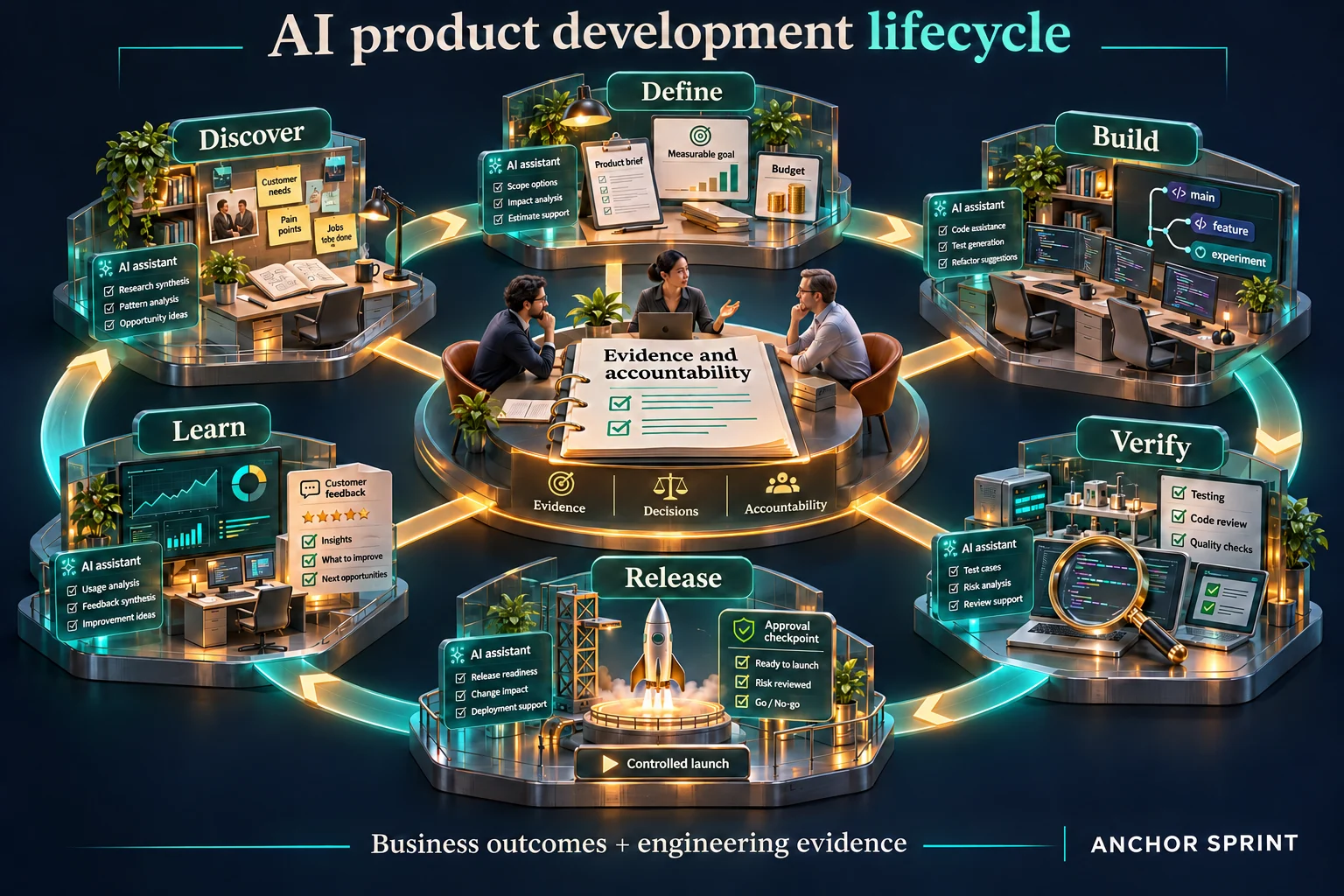
| Stage | Useful agent contribution | Engineering evidence | Business owner and decision |
|---|---|---|---|
| Discover | Organise approved research, inspect the current system, and identify unanswered questions. | Current workflow, constraints, dependencies, and evidence gaps. | Product owner validates the customer problem and baseline cost. |
| Define | Draft a product brief, acceptance examples, implementation options, and an evaluation plan. | Testable requirements, scope boundaries, data assumptions, and architecture decisions. | Product and engineering leads choose scope, success measures, budget, and accountable owners. |
| Prototype | Build a constrained prototype with Codex or Claude Code and generate evaluation fixtures. | Runnable demonstration, representative cases, failures, latency, and estimated operating cost. | Users and product owner decide whether the proposed workflow solves the problem. |
| Build | Implement bounded goals, use reviewed skills, and delegate independent tasks. | Versioned changes, dependency records, unit tests, and integration checks. | Engineering lead owns implementation scope and delivery commitments. |
| Verify and review | Add local review, PR review, security analysis, and selected repair agents. | Test results, reproducible findings, evaluation reports, and unresolved risks. | Engineering and risk owners decide whether evidence supports acceptance. |
| Release | Prepare release notes, deployment checks, migration steps, and rollback instructions. | Required checks, approvals, monitoring readiness, and a tested rollback procedure. | Release owner authorises rollout under the organisation's policy. |
| Operate | Investigate approved logs, triage incidents, and propose corrections through controlled automation. | Reliability, incidents, user reports, data or model drift, and cost per successful operation. | Service owner decides escalation, rollback, capacity, and support priorities. |
| Learn or retire | Compare observed outcomes with the baseline and assemble the next experiment. | Adoption, accepted outcomes, defect trends, evaluation changes, and remaining dependencies. | Product and business owners continue, change, or retire the feature based on measured value. |
For an AI product, version the prompt, model configuration, retrieval sources, and tool permissions alongside the software release. Test the complete workflow on representative cases, including refusals, missing data, and incorrect tool results.
Our suggestion: require two evidence sets at each release. Engineering evidence shows that the implementation meets its criteria. Business evidence shows that users achieve the intended outcome within acceptable cost and risk.
Need a workflow for your team? Explore AI SDLC workflow design with Anchor Sprint.
Worked AI development example: a support-ticket triage assistant
Consider a team building an assistant that classifies support tickets and drafts suggested replies. This is an illustrative product example. It is not a claim about an Anchor Sprint deployment or measured customer results.
The product goal is shorter handling time with acceptable classification quality and clear human escalation. The development goal is a tested implementation. Treat those goals separately throughout the AI SDLC.
| Stage | Concrete activity | Evidence and decision |
|---|---|---|
| Discover and define | Product owner reviews approved ticket samples and measures current handling time and error patterns. | A product brief states eligible ticket types, exclusions, baseline measurements, and the person accountable for success. |
| Design | Engineer compares a rules-based route, an AI classifier, and a human-only route. Use synthetic or approved examples. | A design record covers data boundaries, model choice, retrieval needs, operating cost, fallback, and escalation. |
| Implement | Use Codex or Claude Code to build one package under a bounded goal. Keep fixtures and acceptance checks versioned. | The implementation passes software tests and a separate ticket-evaluation set. Failures and model configuration are recorded. |
| Review and repair | Run local review, then the selected PR review service. A repair agent may propose fixes under defined permissions. | Engineers reproduce findings and rerun original checks. The configured approval policy decides who must authorise the change. |
| Release | Roll out to a limited group with suggested replies only. Keep sending under the approved human-controlled workflow. | Release evidence includes access checks, monitoring, rollback, support ownership, and a reviewed operating procedure. |
| Operate and learn | Measure handling time, correction effort, incorrect classifications, escalations, and cost per successfully handled ticket. | The product owner compares results with the baseline and chooses to expand, revise, or stop. Passing code tests alone cannot settle this decision. |
Read PRODUCT.md, ARCHITECTURE.md, and EVAL.md.
Implement ticket classification and reply drafting in the scoped package.
Use synthetic fixtures; do not connect to production customer data.
Keep sending disabled in this prototype.
Run the software tests and the separate ticket-evaluation command.
Record model configuration, failures, and escalation behaviour.
Return the diff, test evidence, evaluation results, and operating risks.
Do not describe prototype test results as customer impact.
1. Architecture: distinguish the client, model, and execution host
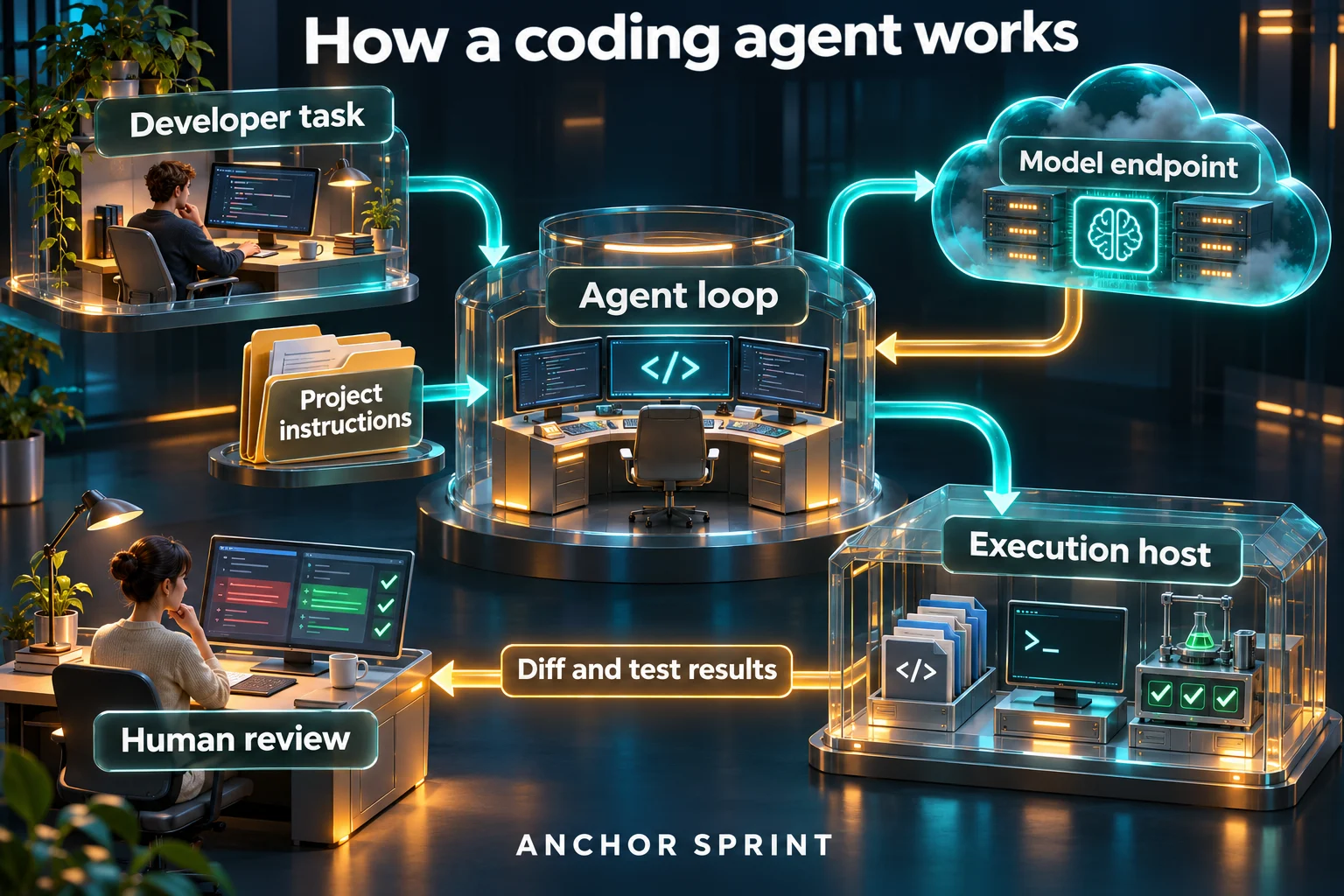
A coding agent combines a model with tools, instructions, and an execution loop. The loop collects context, proposes actions, runs tools, and evaluates results. Tool permissions and the execution host determine what those actions can affect.
Codex CLI operates against your local repository and installed tools. Codex Cloud moves task execution to a separate remote workspace. 1 3
Claude Code also supports local execution and cloud sessions. Its cloud documentation distinguishes Anthropic-hosted infrastructure from an organisation's self-hosted environment. 2 4
Local execution does not mean local model inference. Check where model requests go, which files enter those requests, and where transcripts remain. A private execution host does not automatically keep model inference inside your network.
2. Models, reasoning, and context management
Codex lets you select models and reasoning effort on supported clients. The checked documentation includes GPT-6.2 Sol examples. Model availability differs across surfaces and accounts. 5
Claude Code accepts aliases such as sonnet and opus, plus explicit model IDs. The checked direct API aliases resolve to Sonnet 5.5 and Opus 5.5. Other providers can resolve them differently. 6
These model names are dated examples, not permanent defaults. Record the actual model, client version, effort, provider, and fallback behaviour for each evaluation. Matching effort labels across vendors does not establish equal compute or cost.
A context window is the material a model can process in one request. A larger window alone does not prove better repository understanding. Retrieval, selected files, tool output, compaction, and task boundaries affect the useful information available.
For large repositories, supply the package boundary, entry points, build command, failing test, and acceptance criteria. Ask each agent to identify missing evidence before editing. Keep durable decisions in reviewed repository files.
- Avoid a single fixed context-size comparison without naming the model, provider, and enabled context mode.
- Use separate tasks for unrelated investigations. Save a short handover before a long conversation loses important decisions.
- Measure retrieval mistakes: wrong package, missed dependency, stale assumption, or changes beyond the requested scope.
3. Repository instructions and configuration portability
Codex builds an instruction chain from global guidance and project directories down to the working directory. It prefers AGENTS.override.md over AGENTS.md at each level. The documented default combined instruction limit is 32 KiB. 7
Claude Code uses CLAUDE.md, scoped rules, and auto memory. Direct AGENTS.md support requires version 2.1.277 or later and has session limits. By default, an applicable CLAUDE.md or CLAUDE.local.md takes precedence over AGENTS.md. 8
For a shared repository, keep common engineering rules in AGENTS.md. A CLAUDE.md file can import it with @AGENTS.md. Verify the loaded instructions in each client after configuration changes. Do not assume that either tool reads the other's overrides or extension settings.
Codex loads project .codex/config.toml layers only for trusted projects. Keep shared defaults separate from administrator requirements and personal settings. 31
# Engineering rules

- Use Node.js 20 for this repository.
- Run npm run check and npm test after code changes.
- Run npm run build after route changes.
- Keep changes within the requested package.
- Report failed checks and unresolved assumptions.
- Do not publish or deploy without explicit permission.
4. Permissions, sandboxing, and the Windows difference
A permission decision authorises an action. A sandbox limits the resources an action can reach. These controls serve different purposes. Prompt instructions alone do not enforce either boundary.
Codex documents an operating-system sandbox and a separate approval policy. Workspace write access and network access are configurable. Non-interactive execution defaults to read-only. 9 21
Claude Code supports tool permission rules and managed policies. Its built-in shell sandbox covers shell commands and their child processes. File tools, MCP servers, and hooks run outside that shell sandbox. 10 11
On Windows, Codex documents a native sandbox with several implementations and compatibility limits. Claude Code documents unsandboxed native Windows commands. Its built-in shell sandbox requires macOS, Linux, or WSL2. This distinction matters when your team must run PowerShell or Windows-specific build tools. 11 12
Our recommendation: test denied file access, denied network destinations, child processes, and external tools using harmless fixtures. Record what the active configuration actually blocks. Repeat these checks after client and policy updates.
- Treat repository content, downloaded files, issue text, and tool responses as possible sources of hostile instructions.
- Use a disposable environment for unfamiliar repositories. Remove unrelated credentials from that environment.
- Review the scope of each MCP server and hook separately. A shell restriction does not describe every integration's access.
5. Skills, MCP, plugins, and hooks
Both products support reusable skills and plugins. Skills package instructions and supporting resources. Claude Code supports the Agent Skills standard with additional fields. Shared skill content still needs testing in each runtime. 13 14
Both products can connect to Model Context Protocol servers. MCP exposes external tools and information, such as documentation, tickets, or database lookups. A shared protocol does not make authentication, configuration files, tool approval, or connection scope identical. 15 16
Both products document lifecycle hooks. Hooks can run checks or other integrations at selected events. Their event schemas and trust rules differ, so copying a hook configuration between products is unsafe. 17 18
Choose the extension type by responsibility. Put engineering facts in project instructions, repeatable procedures in skills, external system access in MCP, and deterministic checks in scripts. Keep required release checks in CI even when a hook also runs them locally.
6. Subagents, worktrees, and concurrent changes
Codex supports subagents and configurable agent definitions. Separate agents can investigate different questions and return summaries. Each agent adds model and tool usage. 19
Claude Code custom subagents have their own context, system prompt, tools, and permissions. Their requests count toward the same usage limits. Its documentation distinguishes subagents from separate sessions and coordinated teams. 20
Parallel research can reduce elapsed time when tasks are independent. Parallel edits can also create merge conflicts and inconsistent assumptions. Use separate Git worktrees for independent implementations and define file ownership before editing.
For a fair comparison, record agent count and aggregate cost. Compare one agent against one agent first. Evaluate parallel workflows separately with the same budget and completion criteria.
7. CLI automation, structured output, and SDK integration
Codex uses codex exec for scripts. Its --json option emits JSONL events; --output-schema requests a schema-shaped final response. Progress normally goes to stderr and the final response to stdout. 21
Claude Code uses claude -p for non-interactive work. It supports JSON and stream-json output. With --json-schema, structured results appear in structured_output. Your parser must handle missing output and errors. 22
These examples inspect a repository. They require an installed client, valid authentication, and reviewed project configuration. The guides below document the flags; this article does not claim a live account execution test.
# Codex: read-only execution with machine-readable events
codex exec --sandbox read-only --json \
  "Identify the test command. Do not edit files."

# Claude Code: text task with a JSON result envelope
claude -p "Identify the test command. Do not edit files." \
  --output-format json
Trust behaviour also differs. Codex documents restrictions on project configuration and project MCP servers in untrusted non-interactive runs. Claude -p can load project hooks and MCP configuration without an interactive trust dialogue. Claude's --bare mode skips automatic discovery, but also changes authentication requirements. Review these details before processing untrusted repositories in CI. 21 22
For application integration, Codex documents SDK control and an app-server protocol for custom clients. The former Codex MCP-server command has been removed. Claude documents Python and TypeScript Agent SDKs. These SDKs run agent workflows; a raw model API is a different integration level. 23 22
In CI, keep the agent on a short-lived runner with minimum credentials. Treat its output as a proposal. Parse errors explicitly and require independent build, test, and review checks before merging.
8. Cloud tasks, model providers, and enterprise deployment
Codex Cloud supports reusable environments and a separate workspace for each task. Its current documentation distinguishes these environments from legacy cloud paths. Do not apply legacy network or secret-handling assumptions to every current environment. 3 9
Claude Code cloud sessions can use Anthropic-managed or self-hosted environments. Network controls and credential handling differ between these routes. A cloud session is also different from remote control of a local session. 4
Claude Code documents direct Anthropic access, Amazon Bedrock, Claude Platform on AWS, Google Cloud routes, and Microsoft Foundry. Authentication, billing, model availability, and feature access vary by provider. 24
Codex also documents Amazon Bedrock for local surfaces using OpenAI models available there. Therefore, “only Claude Code supports Bedrock” is not an accurate current distinction. Confirm the required model, region, client, and feature set before choosing that route. 25
Our enterprise recommendation: evaluate execution location and inference location independently. Document identity, source control permissions, model routing, network destinations, logs, retention, and incident ownership for the chosen deployment.
9. Pricing: compare cost per accepted change
The prices below are public USD list prices checked on 24 November 2026. Billing periods differ. Taxes, foreign exchange, regional checkout prices, and enterprise terms can change the final cost.
OpenAI lists ChatGPT Plus at US$20 monthly and Pro options at US$100, US$200, or US$500 monthly. Codex usage depends on plan allowances and eligible additional usage. API-key sessions use separate API billing. 26
Anthropic lists Claude Pro at US$20 monthly, or US$200 billed annually. Max is US$100 monthly and Ultra is US$200 monthly. Claude Code is included in these paid plans, with usage conditions. 27
Claude's usage screen distinguishes subscription limits from additional usage credits and API costs. An API-equivalent session cost is not automatically the subscription charge. 28
Neither subscription price gives a fixed number of completed engineering tasks. Long context, repeated attempts, model selection, faster modes, and parallel agents can change consumption. Trial both products under the same time and spend limits.
Cost per accepted change =
  (allocated subscription cost + extra usage + runner cost
   + review labour + correction labour)
  / accepted changes

Example only, not a vendor quote:
  US$40 tools + US$10 runners + US$150 review and corrections
  / 10 accepted changes = US$20 per accepted change
For Malaysian budgets, use your finance team's current conversion rate and actual invoice terms. Do not convert public USD prices into a permanent RM price promise.
10. Source code, training controls, and data governance
OpenAI's pricing documentation states that Business data is not used for training by default. That statement does not establish the same policy for every consumer account, feedback channel, or external connection. 26
Anthropic distinguishes consumer settings from commercial terms. Commercial Claude Code prompts and code are not used for model training unless the customer opts in. Consumer accounts have a model-improvement choice. Feedback and shared transcripts have separate handling rules. 29
No training is not the same as zero retention. Neither term establishes a storage region, an inference region, or the treatment of external tools. Review the contract and settings for the exact account and provider route.
For a Malaysian organisation, include the chosen route in your existing data review. Record what code and records may leave the environment. Confirm processing locations, retention, deletion, access logs, and approved integrations with the responsible teams.
11. What benchmark evidence can establish
SWE-bench Verified contains 500 human-validated software issue tasks. Its maintainers distinguish full agent systems from models evaluated through a shared minimal agent. They also warn that results from different harness generations are not necessarily comparable. 30
A benchmark score belongs to a particular model, agent configuration, dataset, and budget. It does not automatically rank the complete Codex and Claude Code products. Tool access, retries, context selection, and test execution affect results.
This guide does not report an independent head-to-head benchmark. We found documentation for the capabilities described here, but did not run a controlled trial. Claims such as “always faster”, “best at frontend”, or “better at reasoning” require a defined workload and measured results.
Use vendor benchmarks to form test questions. Use your repository trial to make the purchase decision. Preserve failed attempts and include human correction time in the result.
Advanced workflows: choose the control that matches the task
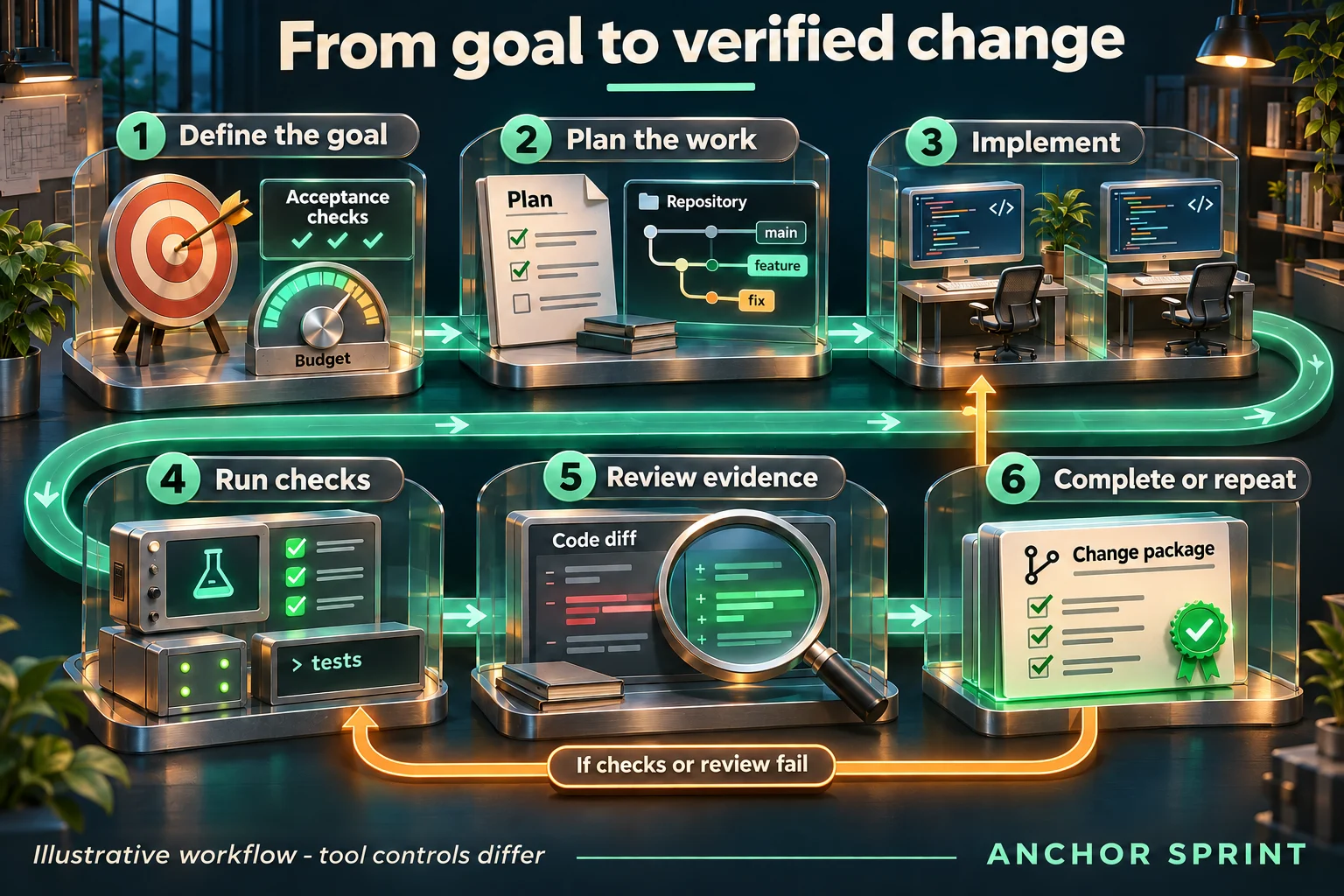
A goal, a workflow, and a schedule solve different problems. A goal defines completion. A workflow organises execution. A schedule or event starts work. A plan describes the intended steps; it does not prove completion.
The following comparison covers the documented product controls. The paired prompts and rollout suggestions are our proposed working patterns. They are examples for readers, not workflows executed during this research.
| Need | Codex | Claude Code |
|---|---|---|
| Plan before editing | /plan proposes an execution plan in supported clients. 33 | /plan enters plan mode before implementation. 54 |
| Continue toward an outcome | /goal keeps an objective attached to the chat across turns. 32 | /goal evaluates completion after turns and continues when the condition remains unmet. 34 |
| Coordinate many workers | Use subagents for independent work and SDK code for application-controlled orchestration. 19 23 | Choose subagents, experimental agent teams, or script-based dynamic workflows. 20 35 41 |
| Recover a long session | Resume saved chats; use worktrees for isolated alternatives. 33 42 | Resume or branch conversations; checkpoints support selected rewind operations. 39 40 |
| Repeat work later | Create scheduled tasks through the desktop app or web; event support varies by surface. 36 | Use cloud tasks for durable triggers, or /loop for in-session polling. 37 38 |
| Capture a repeatable procedure | Package a skill. Record & Replay can turn a demonstrated macOS workflow into a skill. 13 43 | Package a skill; save dynamic orchestration when the execution structure must be repeatable. 14 35 |
Our suggestion: start with one goal and a reliable test command. Add parallel orchestration only after the single-agent process produces reviewable results.
Advanced example 1: a bounded goal for a code migration
Codex documents /goal in the desktop app, CLI, and IDE extension. Its CLI supports viewing, editing, pausing, resuming, and clearing the goal. Existing permissions still apply. 32 33
Claude Code also has /goal. A separate model evaluates the condition from the conversation after each turn. It does not independently run tests. The goal can clear after success, an impossibility judgment, or certain errors. 34
Use a small migration as the first trial. Define the affected package, preserved behaviour, required checks, and evidence needed for completion. Establish the baseline first so existing failures remain distinguishable from new ones.
These examples use the same acceptance criteria. Replace the package and commands with your repository's real checks. A time limit written in a prompt is a behavioural instruction, not an enforced billing cap.
/plan Plan the migration described in MIGRATION.md.
Identify affected packages, existing failures, risks, and acceptance checks.
Do not edit code yet.

After reviewing the plan, send:
/goal Implement the reviewed MIGRATION.md plan in packages/client.
Preserve public API behaviour. Run npm run check and npm test.
All migration acceptance checks must pass. Other failures must exactly
match the recorded baseline. Report them without claiming a clean suite.
Stop and report after three failed correction attempts.
Do not publish, deploy, or change unrelated packages.First, ask for a plan in plan mode:
Read MIGRATION.md and identify affected files and baseline failures.
Explain the migration and acceptance checks before editing.
After reviewing the plan, send:
/goal The MIGRATION.md migration in packages/client is complete.
Public API behaviour is preserved. All migration acceptance checks pass.
Other failures exactly match the recorded baseline. Run npm run check
and npm test; include their actual results without claiming a clean suite.
Stop and report after three failed correction attempts.
Do not publish, deploy, or change unrelated packages.Use the product's own controls to stop a run. In Codex, /goal pause and /goal resume manage a paused goal. In Claude Code, /goal clear removes the active condition. Do not assume that goal-control subcommands are portable.
Our suggestion: require a final report with changed files, check results, unresolved assumptions, and the reason the goal ended. Independently verify important completion claims.
Advanced example 2: parallel review and repeatable orchestration
Codex subagents can split independent investigations. Worktrees give separate chats isolated checkouts. An SDK application can define its own sequencing and integration logic. These are different levels of orchestration. 19 23 42
Claude dynamic workflows execute JavaScript orchestration outside the conversation. The script holds intermediate results and can be saved and rerun. The /workflows view exposes run progress and controls. 35
Claude agent teams are a separate, experimental feature, disabled by default. A lead coordinates peer sessions with shared tasks and messaging. Their documented limitations include resumption, coordination, and shutdown. 41
A similar business outcome does not establish feature parity. Codex goals, skills, and SDK orchestration do not by themselves establish an identical Claude dynamic-workflow runtime. Choose the mechanism whose execution model you can operate and review.
Review this branch without editing files.
Use three subagents: correctness, security, and test coverage.
Give each the same base commit and acceptance criteria.
Require file references and a reproducible check for each finding.
Collect results, remove duplicates, and mark unverified claims.
Return one prioritised report. Do not open or merge a PR.Write a small dynamic workflow for this branch review.
Use separate correctness, security, and test-coverage agents.
Collect structured findings and cross-check candidate issues.
Keep agents read-only. Return evidence and uncertainty for each finding.
Show the orchestration script before running it.
After approval, run it and expose progress through /workflows.
Do not open or merge a PR.The examples are original prompts, not executable workflow scripts. The generated orchestration requires review before execution. Start with read-only workers and a small repository slice.
Our suggestion: assign independent questions to parallel workers. Keep implementation sequential until file ownership and integration checks are explicit. Test the combined change after merging worker results.
Advanced example 3: checkpoints, handover, and recovery
Codex can resume saved CLI chats and use worktrees for isolated alternatives. Resuming a conversation and restoring repository files are separate operations. 33 42
Claude supports continuing, resuming, and branching sessions. Its checkpoints can rewind tracked edits, but shell-only changes and some subagent edits have limits. Checkpoints do not replace Git. 39 40
A saved conversation is not proof that processes, credentials, or external services remain available. Before continuing, check the current commit, working tree, installed tools, and last successful acceptance check.
Before ending this session, write HANDOVER.md with:
- Objective and acceptance criteria
- Current commit, branch, and worktree
- Completed steps and changed files
- Exact checks run and their results
- Known failures and unresolved decisions
- Next smallest useful action

When resuming, read HANDOVER.md and inspect the current repository.
Re-run the last relevant check before making further changes.
Our suggestion: save a Git checkpoint after each verified milestone. Use a reviewed handover file for durable decisions. Avoid saving secrets or complete private logs in that file.
Advanced example 4: timed loops, scheduled work, and events
Codex scheduled tasks can run against local projects through the desktop app. Local runs need the computer and app available. Web tasks have different context and connection access. The CLI and IDE do not provide the Scheduled management interface. 36
Claude /loop repeats a prompt inside a session. It is useful for temporary polling. Cloud scheduled tasks work independently of an open local session and can use time, GitHub, or API triggers. 37 38
A loop asks what should run again. A goal asks whether an outcome is complete. A scheduled task asks when a new run should start. Combine them only when each control has a defined responsibility.
| Scenario | Codex approach | Claude Code approach |
|---|---|---|
| Daily repository report | Desktop scheduled task in a local project or worktree. Keep the host available. 36 | Cloud scheduled task for a fresh remote checkout, or a Desktop task when local tools are required. 37 38 |
| Temporary status polling | Use the active task or a reviewed polling script. Do not assume a matching /loop command. | Use an explicit interval, such as /loop 5m, while the session remains available. 38 |
| Repository events | Eligible web/mobile tasks support selected GitHub activity. Event tasks are not available through every client. 36 | Configure a cloud task's GitHub trigger. API triggers use a separate authenticated endpoint. 37 |
Create a weekday task at 09:00 Asia/Kuala_Lumpur.
Use this repository in an isolated worktree.
Read commits since the previous successful run.
Run the approved checks and write a local change report.
Include failures and skipped checks.
Do not send messages, publish changes, or merge branches.
Show the schedule, repository, and permissions before saving.For temporary polling in an open session:
/loop 5m Check the CI status for this branch and report changes.
For a cloud schedule, configure a separate task:
/schedule weekdays at 09:00 Asia/Kuala_Lumpur, review recent commits
in the selected repository and produce a change report.
Review the repository, environment, permissions, and trigger before saving.These examples do not create tasks on your account. Cloud and local environments need different credentials and network access. Confirm the actual timezone and next run before enabling a schedule.
Our suggestion: begin with reports and proposed patches. Add external actions only after you verify the trigger, credentials, repeated-run behaviour, and review process.
Advanced example 5: improve against evidence instead of repeated prompting
OpenAI describes evaluation-driven improvement loops: identify a scoring command, make focused changes, rerun checks, and inspect resulting artifacts. This is a working method, not evidence that Codex outperforms Claude Code. 44
The same engineering method can guide either product. Use deterministic tests for objective conditions and human review for subjective quality. Keep a holdout set so repeated changes do not merely fit the visible examples.
Goal: improve the failing cases in EVAL.md.
First record the baseline score and runtime.
Use the listed evaluation command without changing its scoring rules.
Make one focused change per iteration.
After each change, rerun evaluation and log the result.
Preserve passing cases and inspect the produced artifacts.
Stop when acceptance criteria pass, after three failed attempts,
or when a product decision is required.
Return the best verified change and explain remaining failures.
A model-written score is not independent evidence by itself. Keep the test harness, acceptance criteria, and review records outside the implementation changes when practical.
Our suggestion: automate repeatable checks through hooks or CI. Use agent judgment to investigate failures, then verify the fix through the original acceptance test.
Our suggestions: adopt advanced features in this order
This sequence is our recommendation for engineering teams. Advance when the preceding stage produces useful evidence and manageable review effort.
Start with one bounded task
Use one agent, one package, and a testable outcome. Compare both products on the same starting commit.
Add a goal and recovery record
Define completion, retry limits, and escalation conditions. Save verified milestones and a handover file.
Package the stable procedure
Turn a repeated process into a reviewed skill. Keep project facts separate from procedure instructions.
Add read-only parallel review
Give workers separate questions and require evidence. Measure total usage and review time before adding more workers.
Add scheduled reports
Use an isolated environment and minimum access. Inspect initial runs before enabling patch creation or external actions.
Move repeatable orchestration into code
Use an SDK or documented workflow runtime when explicit branching, aggregation, and recovery justify the extra operating complexity.
For repetitive computer tasks on macOS, Codex Record & Replay offers another route into a reusable skill. It requires Computer Use access. Do not assume the same recording feature exists on Windows. 43
For a Windows engineering team, test the real shell, build tools, and isolation policy before choosing advanced automation. For a large migration, prioritise resumable state and integration checks. For daily maintenance, prioritise reliable triggers and reviewable output.
Avoid enabling every feature at once. More workers, retries, hooks, and schedules can increase cost and make failures harder to trace. Expand only when the simpler workflow exposes a specific limitation.
Related agentic products: review, repair, security, and approval
An IDE extension, a review service, a repair agent, and an approval-policy service are different product layers. They can complement the coding agent. Compare their permissions, host, billing, and authority separately.
Codex provides local /review and pull request review workflows. GitHub integration supports @codex review and automatic reviews. Security Review is documented as a research preview. 45 46
Claude's managed Code Review uses multiple agents and verifies candidate findings. It reads the code without building or running it. It differs from asking a local Claude Code session for a review. 47
| Product or layer | Engineering role | Business and operating implication | Important limit |
|---|---|---|---|
| Codex local and PR review | Investigate local changes or review source-host pull requests. 45 46 | Adds a review step alongside implementation; measure useful findings and reviewer time. | Local review, interactive PR review, and automatic cloud review have different triggers and access. |
| Claude Code Review | Hosted GitHub review with verified findings and inline comments; Team and Enterprise. 47 | Token-based organisation billing is separate from included plan usage. Review frequency affects spend. 48 | A review alone does not approve or block a PR. An Approvals policy can use its result. ZDR, HIPAA configuration, and CMEK exclusions apply. |
| Claude PR Steward | A Claude Ship agent that pushes fixes for failing checks, conflicts, and feedback. 49 | Reduces manual repair coordination when the workflow fits; track correction quality and repeated review cost. | Public beta. Designed not to approve or merge. Branch protection and authorised policy still determine release conditions. |
| Claude Approvals | Applies an approval policy and can allow Claude approving reviews on selected changes. 49 | Requires a deliberate decision about delegated approval authority and residual accountability. | Public beta. Policy and required GitHub checks determine enforcement; some configurations allow merging without a person's approval. |
| Codex Security | Security scans, evidence, and proposed remediation through product, plugin, CLI, or SDK workflows. 50 | Adds security triage and remediation work; budget scan cost and human verification separately. | A security-analysis product is different from the sandbox controlling the coding agent. Confirm access and deployment requirements. |
| Claude Security plugin | Scans repositories or changes in a Claude Code session and produces findings and selected patches. 51 | Uses the session's available models and usage; useful for a controlled scan-and-remediate process. | The plugin differs from the managed Enterprise Claude Security service and from PR Code Review. |
| GitHub Copilot code review | Agentic review and suggested fixes across supported GitHub and editor workflows. 52 | A relevant alternative when GitHub policies and existing Copilot procurement fit the team. | Plan and policy conditions apply. Approval assessments and enabled approving reviews have different effects. |
| CodeRabbit | Review, triage, change explanation, app verification, security, and coding-agent products. 53 | A complementary vendor option when the bottleneck spans review queues and verification. | These are distinct products and surfaces. Confirm plan, repository access, data handling, and execution requirements for each. |
Claude Ship groups Code Review, PR Steward, and Claude Approvals. Code Review is generally available; the other two are public beta. The configuration can enable automatic progression, so assess the full policy rather than assuming every change waits for a person. 49
Claude Code Review is not available with Zero Data Retention, HIPAA configuration, or customer-managed encryption keys. Confirm this before proposing it for a restricted environment. 47
Our suggestion: evaluate one implementation agent with one review layer first. Adding several reviewers can duplicate comments, increase charges, and obscure ownership. Keep deterministic tests and release controls outside the reviewers' recommendations.
Business evaluation: buy an improved delivery process, not more generated code
The engineering question is whether an agent produces an acceptable change. The business question is whether the complete process improves customer outcomes and total delivery cost. Track both before expanding licences or automated authority.
Begin with a measured bottleneck: slow investigation, difficult migrations, review queues, repeated CI repairs, or maintenance backlog. Choose an agent or extension that addresses that bottleneck. A code-generation purchase does not automatically resolve a release-approval queue.
The metrics below are our proposed pilot scorecard. They are not vendor performance claims or guaranteed savings.
- Set a baseline and pilot scope before procurement. Record the team, tasks, starting system, and acceptance threshold.
- Separate trial expense from recurring operating cost. Include onboarding, configuration ownership, and model or client upgrade work.
- Use provider or service spend controls for enforceable budgets. A prompt requesting a spending limit is not the same control.
- Assign an owner to each automated step. Decide who can enable write access, change approval policies, and authorise external actions.
- Compare the combined workflow with the current process. Do not count output volume or lines generated as business value.
| Measure | Engineering view | Business interpretation |
|---|---|---|
| Accepted-change lead time | Measure request to accepted deployment, including review and correction. | Shows whether delivery improves across the whole process. |
| Quality after release | Record incidents, escaped defects, rollbacks, and support effort. | Checks whether faster delivery transfers cost to users or operations. |
| Review usefulness | Measure valid actionable findings, false positives, and review minutes. | Shows whether a review extension reduces the bottleneck rather than adding noise. |
| Total cost | Include licences, usage, reviews, runners, setup, evaluation, and human labour. | Supports a purchase decision based on the accepted outcome. |
| Customer outcome | Instrument task success, completion time, errors, and user feedback. | Tests the original product hypothesis and supports continuation or retirement. |
| Operational control | Test access boundaries, audit evidence, recovery, and policy changes. | Shows whether the organisation can own and support the expanded automation. |
Our suggestion for a small team: one coding agent, ordinary CI, and a limited PR-review pilot. For a large organisation, add central policy, representative evaluation cases, telemetry, and a named operating owner before wider rollout.
For an AI product, include inference and retrieval cost per successful user task in the business case. Keep model quality, software correctness, and business success as separate measures.
A weighted CTO scorecard and rollout decision
Use the same scorecard for both tools after the mandatory requirements pass. The weights below are a suggested starting point. Agree them before the pilot; change them to match the organisation's priorities.
Score each category from zero to five using recorded evidence. Mark missing evidence unknown rather than assigning a neutral score. A weighted total must not override a failed mandatory requirement.
Confirm mandatory requirements
Record product and deployment requirements. Reject incompatible routes and resolve material unknowns before scoring.
Run a constrained pilot
Use matched tasks, comparable budgets, independent acceptance checks, and a named pilot owner.
Review total process evidence
Combine engineering outcomes, operational failures, customer measures, and actual cost. Preserve failed attempts in the comparison.
Select the smallest useful rollout
Choose one tool, a justified mixed setup, or no expansion. Assign owners and define review and rollback conditions.
Reassess after material changes
Repeat relevant checks after model, client, provider, policy, or workflow changes. Do not treat the initial ranking as permanent.
| Category | Suggested weight | What the CTO should inspect |
|---|---|---|
| Accepted engineering outcome | 25% | Correctness, maintainability, acceptance tests, scope control, and defects after release. |
| Security and governance | 20% | Approved data handling, identity, sandbox evidence, extension access, and approval authority. |
| Workflow integration | 15% | Repository and editor fit, cloud provider compatibility, CI integration, and existing review processes. |
| Operational ownership | 15% | Recovery, observability, repeatable configuration, upgrades, incident handling, and support ownership. |
| Total economics | 15% | Tool and add-on charges, runner costs, setup, review labour, correction work, and successful customer outcomes. |
| Team adoption | 10% | Training effort, usability, instruction consistency, developer feedback, and ongoing configuration workload. |
The decision record should name the preferred tool and deployment route, evaluated versions, evidence, exclusions, remaining risks, pilot cost, and approval owner. Record why rejected options did not fit.
Our suggestion: buy the operating model your team can verify and maintain. Use Anchor Sprint's workflow-design engagement when tool selection and process redesign need one coordinated scope.
AI SDLC consulting and workflow design with Anchor Sprint
Anchor Sprint can help your team design an AI-assisted software development workflow around your product goals, repositories, and operating requirements. Start with one delivery bottleneck and a representative pilot.
We can scope this work for teams in Malaysia and Singapore. The workflow should fit your delivery process, existing systems, and accountable owners.
The scope can cover tool selection, agent roles, project instructions, skills, review services, engineering checks, permissions, and operating ownership. Choose the scope before adding automation or expanding licences.
A proposed workflow-design engagement should make the following outputs clear. Final scope and responsibilities depend on your environment and agreed requirements.
Map the current delivery process
Identify delays, handoffs, systems, data boundaries, and decision owners. Establish the engineering and business baseline.
Design the target AI SDLC
Define where Codex, Claude Code, review products, and existing tools fit. Specify the work each agent may perform.
Define checks and approval boundaries
Record acceptance criteria, access controls, review responsibilities, release conditions, rollback steps, and escalation routes.
Specify enterprise integrations
Map identity, policy delivery, detection, inference gateways, audit export, and spending controls. Define route-specific acceptance tests and integration owners.
Prepare and measure a pilot
Select representative tasks and cost limits. Compare accepted outcomes, review effort, delivery time, and operational risk against the baseline.
Prepare the operating handover
Document configurations, reusable procedures, training needs, maintenance ownership, and the evidence required before expanding the workflow.
Bring a representative repository, an example change request, your current review process, and your operating constraints. Use sanitised examples when access has not been approved.
Discuss your AI development workflow or explore our software development services.
12. A reproducible two-week evaluation plan
The following method is our proposed evaluation procedure. It is not a published finding about either product.
Choose representative tasks
Select 12 to 20 recent tasks across bug fixes, small features, refactoring, tests, and documentation. Include difficult cases and clear acceptance criteria.
Freeze the starting conditions
Use the same repository commit, dependency lockfile, instructions, tools, and network policy. Create a separate branch or worktree for each run.
Record the full configuration
Save the client version, actual model ID, provider, effort, enabled extensions, agent count, and permissions. Record fallback models when they occur.
Control intervention and budget
Give both tools the same prompt, time budget, and retry limit. Log every clarification and manual correction. Alternate their run order.
Verify independently
Run hidden acceptance tests where practical. Review correctness, scope, security, and maintainability without revealing which tool produced the change.
Report distributions and failures
Compare acceptance rate, median and slow-case completion time, review minutes, correction time, and cost. Repeat a subset to check variability.
| Record | What to capture | Why it matters |
|---|---|---|
| Identity | Task ID, commit, client, model, provider, effort | Makes the run traceable. |
| Controls | Instructions, permissions, network, extensions, agent count | Shows whether the conditions were comparable. |
| Outcome | Acceptance result, failed checks, rejected changes | Counts useful results rather than generated code. |
| Effort | Elapsed time, review minutes, corrections, retries | Includes work transferred to the reviewer. |
| Cost | Plan allocation, usage charges, runner and labour cost | Supports cost per accepted change. |
Set the decision rule before testing. For example, require zero critical access-policy violations and a lower total review cost than the current process. Treat a small trial as directional evidence and expand it before a large rollout.
A mixed rollout can be reasonable if measured strengths differ by task. Keep one shared engineering policy and separate product-specific settings. Recheck the result after important model, client, or workflow changes.
Frequently asked questions
Can we connect our own detection tool to Codex or Claude Code?
Both support integration designs, with different coverage. Claude Enterprise Inference hooks can call your security endpoint for governed requests. Codex offers Prisma AIRS for eligible prompt inspection. Local hooks and compatible gateways offer other integration points. Verify content coverage and outage behaviour for the chosen route.
Can we use third-party inference or local models?
Both document cloud-provider and gateway routes. Codex CLI also documents local open source providers through Ollama or LM Studio. Anthropic does not support routing Claude Code to non-Claude models through a gateway. Gateway hosting and model hosting are separate requirements.
Do enterprise settings guarantee policy enforcement and cost caps?
No. Verify managed requirements, authentication, policy delivery, detector failures, and endpoint restrictions on each supported route. Cost visibility does not establish a hard cap. Test actual enforcement, concurrent usage, and permitted overshoot before rollout.
What is AI SDLC?
AI SDLC means an AI-assisted software development lifecycle. It connects requirements, design, implementation, testing, review, deployment, and maintenance. Product discovery and business outcomes sit within the broader PDLC.
Can Anchor Sprint help design our AI development workflow?
Yes. Anchor Sprint can help scope a workflow around your product goals, repositories, tools, controls, and operating needs. A proposed engagement can include a workflow map, tool recommendations, acceptance checks, pilot measures, and handover guidance.
Do Codex and Claude Code support goals and advanced workflows?
Both document /goal. Their controls and completion behaviour differ. Claude Code also documents script-based dynamic workflows. Compare each mechanism's execution, recovery, permissions, and cost before choosing it.
Is Claude Code Review the same as Claude Code?
No. Managed Code Review is a hosted pull request review service. Local review, PR repair, security scanning, and approval policies are separate layers with different access, costs, and authority.
Is Codex only a cloud tool?
No. Codex has a local CLI and IDE extension, as well as cloud workflows. Choose the execution host separately from the model endpoint.
Is Claude Code only a terminal tool?
No. Anthropic documents terminal, IDE, desktop, browser, and cloud workflows. Availability depends on the account, client, and administrator settings.
Can both tools use AGENTS.md?
Yes, with different rules. Codex uses an instruction hierarchy. Claude Code direct support requires version 2.1.277 or later and has configuration and session limits. CLAUDE.md can import AGENTS.md.
Which tool is safer on native Windows?
Codex documents a native Windows sandbox. Claude Code documents unsandboxed native Windows shell commands and requires WSL2 for its built-in shell sandbox. Overall safety also depends on integrations, credentials, and policy.
Which tool is cheaper?
There is no fixed answer per engineering task. Compare plan allowances, additional usage, model choices, runners, and human review. Measure total cost per accepted change.
Does this guide prove one tool produces better code?
No. This guide compares documented capabilities and proposes an evaluation method. It does not report an independent performance benchmark.
Research references and update policy
The core comparison sources were checked on 24 November 2026. Advanced-workflow, review-product, and enterprise-control research was added on 25 November 2026. This guide includes 74 primary references. Vendor documentation describes capabilities; it does not independently establish code quality. Recheck prices, model aliases, platform support, and security defaults before procurement or rollout.
- OpenAI: Codex CLI
- Anthropic: Claude Code overview
- OpenAI: Codex Cloud
- Anthropic: Claude Code cloud sessions
- OpenAI: models and reasoning controls
- Anthropic: model configuration
- OpenAI: AGENTS.md discovery and overrides
- Anthropic: CLAUDE.md, AGENTS.md and auto memory
- OpenAI: agent approvals and security
- Anthropic: permissions
- Anthropic: shell sandbox scope and platform limits
- OpenAI: native Windows sandbox
- OpenAI: skills and plugins
- Anthropic: skills and custom commands
- OpenAI: Model Context Protocol
- Anthropic: Model Context Protocol
- OpenAI: lifecycle hooks
- Anthropic: lifecycle hooks
- OpenAI: subagents
- Anthropic: custom subagents
- OpenAI: non-interactive execution and JSON output
- Anthropic: programmatic execution and JSON output
- OpenAI: Codex SDK and app server integration
- Anthropic: enterprise deployment options
- OpenAI: Codex with Amazon Bedrock
- OpenAI: ChatGPT Work and Codex pricing
- Anthropic: Claude plans and pricing
- Anthropic: costs, limits and usage credits
- Anthropic: data usage and training policies
- SWE-bench maintainers: Verified dataset and evaluation comparability
- OpenAI: trusted project configuration
- OpenAI: Goal mode and long-running work
- OpenAI: planning, goals, and session commands
- Anthropic: goals, evaluation and stop conditions
- Anthropic: script-based dynamic workflows
- OpenAI: scheduled tasks and event triggers
- Anthropic: cloud scheduled tasks and triggers
- Anthropic: session loops and scheduling options
- Anthropic: resume, continue and branch sessions
- Anthropic: checkpointing and rewind limits
- Anthropic: experimental agent teams
- OpenAI: Git worktrees and handoff
- OpenAI: Record & Replay workflow capture
- OpenAI: evaluation-driven improvement loops
- OpenAI: local and pull request code review
- OpenAI: GitHub review integration and Security Review
- Anthropic: managed Code Review and availability
- Anthropic: Code Review costs and spend limits
- Anthropic: Claude Ship, PR Steward and Claude Approvals
- OpenAI: Codex Security scan and remediation workflows
- Anthropic: Claude Security plugin and managed-service distinction
- GitHub: Copilot code review capabilities
- CodeRabbit: review, verification and coding-agent products
- Anthropic: plan and goal command reference
- OpenAI: managed requirements, defaults, and authentication
- Anthropic: managed policy enforcement and failure handling
- OpenAI: Prisma AIRS inspection scope and failure policy
- Anthropic: Enterprise Inference hooks and coverage limits
- Anthropic: Inference hooks enforcement configuration
- OpenAI: enterprise gateway connection and credentials
- OpenAI: Responses API gateway compatibility
- Anthropic: gateway support and model restrictions
- Anthropic: gateway protocol and exceptional outbound traffic
- Anthropic: self-hosted Claude apps gateway
- Anthropic: server-managed settings and eligible authentication
- OpenAI: configuration server
- OpenAI: CLI local open source provider options
- OpenAI: advanced custom provider configuration
- OpenAI: Google Cloud Vertex AI private preview
- OpenAI: enterprise Compliance API
- Anthropic: OpenTelemetry monitoring and sensitive event content
- OpenAI: workspace usage controls and API billing separation
- OpenAI: administrator usage limits and overage controls
- Anthropic: Claude apps gateway spend-limit enforcement
Free consultation
Design your AI development workflow
Anchor Sprint can help map your AI SDLC, select tools, define checks and approval boundaries, and prepare a measured pilot.