

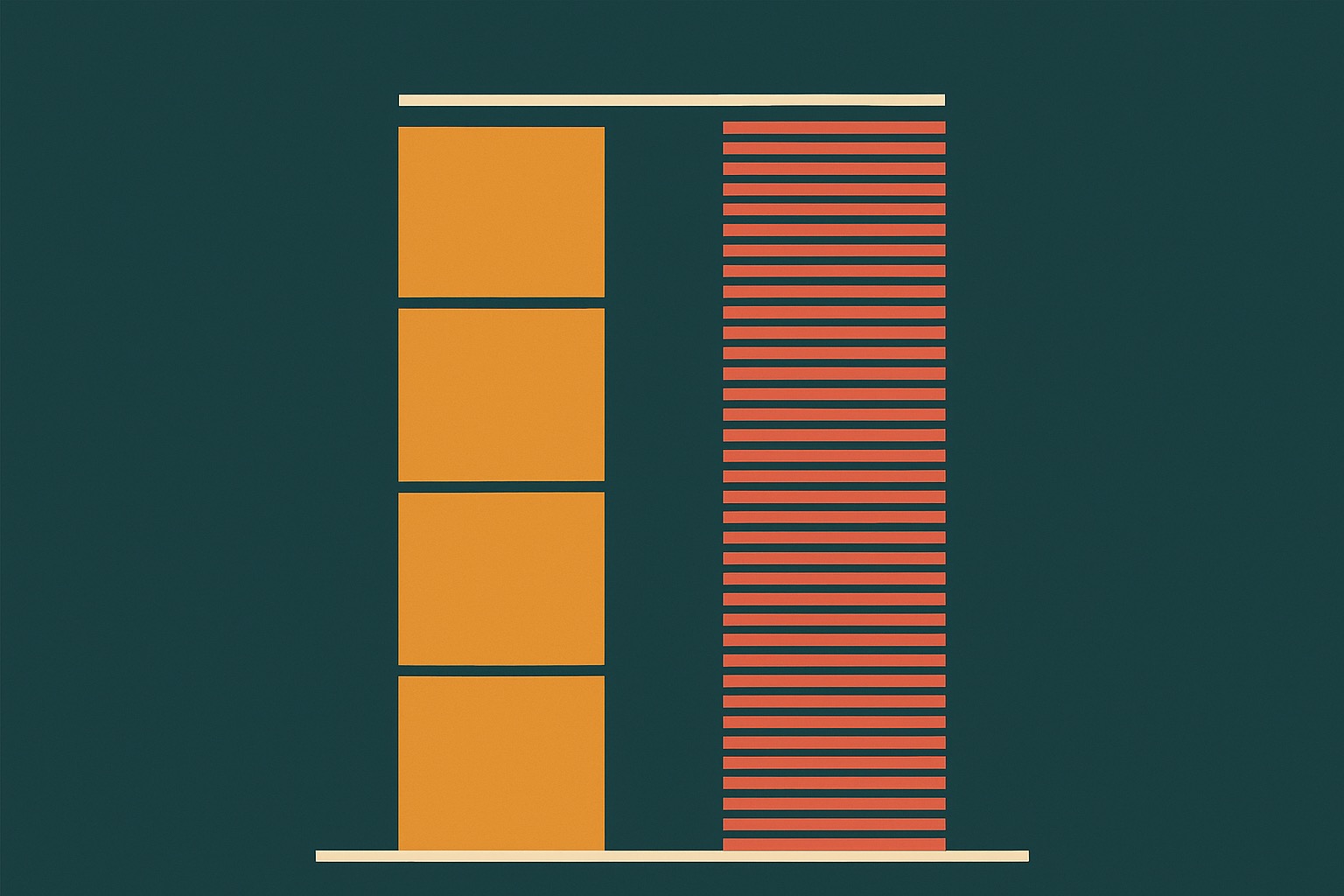
Same height, different granularity. That is the whole problem with comparing per-token prices across model generations.
Updated 12 August 2026 — pricing correction
- Claude Sonnet 5 API rate: was described as introductory $2/$10 rising to $3/$15 on 1 September 2026. Anthropic cancelled that increase — $2/$10 is now the standard rate. Sonnet 4.6 stays at $3/$15, so Sonnet 5 is now the cheaper of the two. See what changed and why.
A finance team running about four thousand supplier invoices a month through an extraction agent asks a reasonable question: the model doing the work is the expensive one, so what happens if we move it down a tier? (That team is a composite drawn from several engagements rather than one named client — but the numbers below are the pattern we keep seeing.)
Run the test and the shape of the result is consistent: the cheaper model handles the large majority of invoices identically. On the remainder — the ones with handwritten annotations, or a credit note stapled to the original — it produces answers that are wrong in a way that looks right. The savings are real. So is the cost of a human checking every line again, because nobody can tell which ones went bad.
That is the actual Opus-versus-Sonnet decision, and it is not the one most comparisons answer.
First: the lineup you are comparing has probably moved
Most of the Opus-vs-Sonnet articles you will find are comparing Opus 4.5 or 4.6 against Sonnet 4.5 or 4.6. That comparison is now out of date, and in a way that changes the answer.
As of August 2026, Anthropic's published lineup runs:
- Claude Fable 5 — $10 per million input tokens, $50 output. Described as next-generation intelligence for long-running agents. This is now the top of the range.
- Claude Opus 5 — $5 input, $25 output. For complex agentic coding and enterprise work.
- Claude Sonnet 5 — $2 input, $10 output. The best balance of speed and intelligence, and now cheaper than the older Sonnet 4.6.
- Claude Haiku 4.5 — $1 input, $5 output. Fastest, near-frontier.
There is also Claude Mythos 5, which shares Fable 5's specifications and pricing but is invitation-only, offered to approved customers under Project Glasswing for defensive cybersecurity work. There is no self-serve sign-up, so if you are reading a comparison that lists it as an option you can buy, that article has not checked.
The first practical consequence: Opus is no longer the top model. If your reason for choosing Opus was "it is the best one", that reason now points at Fable 5. Opus 5 is the middle of a three-model frontier range, not the ceiling.
The second consequence is that context capacity has stopped being a differentiator. Fable 5, Opus 5 and Sonnet 5 all carry a 1 million token context window and 128k maximum output. Haiku 4.5 sits at 200k and 64k. So for the top three, "which one can hold my documents" is no longer a question worth asking. They all can.
The tokenizer change nobody is writing about
Here is the part that matters most, and it is sitting in Anthropic's own pricing documentation where almost nobody reads it:
"Claude 4.7 and later models and Claude Mythos Preview use a newer tokenizer that contributes to their improved performance on a wide range of tasks. This tokenizer produces approximately 30% more tokens for the same text."
Read that again with a bill in mind.
Sonnet 4.6 lists at $3 per million input tokens. Sonnet 5 lists at $2. But Sonnet 5 turns the same invoice, the same contract, the same support thread into roughly 30% more tokens. Cheaper per token, more tokens to pay for — so the headline rate alone tells you nothing.
Per-token prices are not comparable across model generations. Every comparison table that lines up two headline rates and calls the cheaper one cheaper is measuring the wrong thing.
Two caveats we will state plainly, because the exact number matters to your budget and we do not want to give you false precision:
- Anthropic says approximately 30%, and that the increase depends on content and workload shape. Dense structured text behaves differently from prose. Measure your own workload before you plan around a figure.
- This is a cost effect, not a quality one. The newer tokenizer exists because it improves performance. You are getting something for the extra tokens. Whether it is worth it is exactly the judgement this article is about.
The September price rise was cancelled — and it flips the arithmetic
Sonnet 5 launched at $2 per million input tokens and $10 output, described as introductory pricing through 31 August 2026, with a rise to $3 and $15 scheduled for 1 September.
That rise is not happening. Anthropic has made $2/$10 the standard rate. From its pricing documentation:
"The $2/$10 per million input/output token pricing for Claude Sonnet 5, announced at launch as introductory pricing through August 31, 2026, is now the standard price. The previously scheduled increase to $3/$15 per million input/output tokens on September 1, 2026 will not occur."
Put that together with the tokenizer effect and the conclusion reverses. Sonnet 4.6 is still $3 per million input tokens. Sonnet 5 is $2 as the standard rate, and produces roughly 30% more tokens for the same text:
- Sonnet 4.6 — $3 per million, 1.0× tokens → an effective 3.00 for a given document.
- Sonnet 5 — $2 per million, about 1.3× tokens → an effective 2.60 for the same document.
The newer model is roughly 13% cheaper for the same work. Under the cancelled September rate it would have been about $3.90 — some 30% more expensive than the model it replaced. That is a large swing, and it lands in your favour.
Two things to hold onto before you budget on it. The 30% is Anthropic's own approximately, and it moves with content and workload shape, so 13% is a direction rather than a number you should put in a spreadsheet. And if you priced a pilot in July expecting a September increase, your forecast is now wrong in the pleasant direction — worth revisiting rather than leaving as unclaimed headroom.
You can model your own numbers with our Claude cost calculator, and the full plan-by-plan breakdown in ringgit is in the Claude pricing Malaysia guide.
Thinking modes, which get reported wrong constantly
This one produces more incorrect blog posts than anything else in the range, so it is worth being precise.
- Extended thinking — the mode you switch on with
thinking.type: "enabled"— is available on Claude Haiku 4.5 only. Fable 5, Opus 5 and Sonnet 5 do not offer it. - Adaptive thinking is the reverse: Fable 5 (always on), Opus 5 and Sonnet 5 have it. Haiku 4.5 does not.
So the frontier models think adaptively without being told to, and the small fast model is the one you explicitly hand extra thinking budget. If you have carried a code pattern forward from an earlier Claude generation that sets thinking.type on an Opus or Sonnet call, that is worth checking today.
Where the money actually goes: caching
Before choosing a model to save money, look at caching, because the multiplier there is larger than the gap between tiers.
Across the range, cache hits and refreshes cost 10% of base input. Cache writes cost 1.25× base input for the five-minute window and 2× for the one-hour window.
For Opus 5, base input is $5 per million. A cache hit is $0.50. A one-hour cache write is $10.
Think about what that means for an agent. A support-triage agent re-sends the same system prompt, the same policy document and the same tool definitions on every single call. Cached, that stable prefix costs a tenth. Uncached, you pay full rate for identical bytes thousands of times a day.
We have seen prompt caching change a bill by more than moving from Opus to Sonnet would have. It is also lower risk, because it changes nothing about output quality. If you have not implemented caching, model selection is the wrong optimisation to be arguing about.
How we actually route work
Across the agent builds documented in our use-case directory, the routing rule that has survived contact with production is not about difficulty. It is about what happens when the model is wrong.
Sonnet 5 handles the work where errors are visible. Drafting, summarising, classification with a human reading the output, first-pass extraction that someone reviews anyway. If a mistake surfaces immediately to a person who can catch it, the cheaper model is correct — and Sonnet 5 is fast, which matters more than people expect for anything interactive.
Opus 5 handles the work where errors are silent. Reconciliation, contract review, anything where the output flows into another system without a human reading it first. The awkward minority in that invoice story is the whole argument: a wrong answer that looks right, entering a ledger unchallenged, costs more than the model ever saved.
Fable 5 is for long-running agents — the ones that hold a task across many steps and tool calls, where small reasoning errors compound over a session rather than showing up in one response. At $10 and $50 it is the most expensive option by a distance, and most workloads do not need it. Reach for it when the failure mode is drift over a long run, not a wrong answer in a single turn.
Haiku 4.5 is for volume where the task is genuinely simple — routing, tagging, extracting one field from a known format. Note its knowledge cutoff is February 2025, considerably earlier than the 5-series, which matters if your task depends on recent facts.
One more thing worth knowing: Opus 5 has a reliable knowledge cutoff of May 2026 — later than Fable 5 and Sonnet 5, both at January 2026. For work that touches recent regulation or recent tooling, the mid-tier model is the better-informed one. That is not what anyone expects, and it is the sort of detail a benchmark table will not tell you.
A short decision list
Work through these in order. The first one that matches is your answer.
- Have you implemented prompt caching? If not, do that first. It is a bigger lever than model choice and costs you no quality.
- Does a human read every output before it goes anywhere? Sonnet 5.
- Does the output flow into another system unreviewed? Opus 5. Pay for the quiet failures you will not otherwise catch.
- Does the agent run long, across many steps, where errors compound? Fable 5.
- Is the task one narrow operation at high volume, on a stable format? Haiku 4.5 — but check the February 2025 cutoff against your task.
- Budgeting past September? The rise was cancelled — Sonnet 5 stays at $2 and $10. Budget the tokenizer effect instead; that is the variable that still moves your bill.
If you want the wider view across vendors rather than within the Claude range, we compare the three major assistants for business use in ChatGPT vs Claude vs Gemini for Malaysian business. And the discipline for proving any of these choices with evidence rather than vibes is in our scorecard guide.
The honest summary
Opus 5 and Sonnet 5 are closer than the price gap suggests, and the deciding factor is not capability. Both carry a million tokens of context. Both think adaptively. The real questions are whether a human sees the output before it matters, whether you have cached the parts of your prompt that never change, and whether your budget is built on introductory pricing that expires this month.
Get those three right and the model choice mostly makes itself.
Free consultation
Not sure which model your workload should be on?
Tell us what the agent does and what happens when it gets something wrong. We will tell you which tier fits — including when the answer is the cheaper one, which it often is.
See how we build production AI agents