

Last week at Computex in Taipei, Jensen Huang held up a chip and made a claim that should make every business owner pause: a quiet desktop machine, sitting on an ordinary desk, that delivers a petaflop of AI performance. No server room. No cloud account. No monthly bill from an AI provider.
That chip is the NVIDIA RTX Spark, and the machines built on it ship later this year from ASUS, Dell, HP, Lenovo, Microsoft, and MSI. The marketing focuses on gaming and creative work. But the question it quietly puts on the table for Malaysian SMEs is more interesting: should the AI your business depends on live in your office, or in the cloud? For the first time, local AI for business in Malaysia is a desk-sized, off-the-shelf purchase rather than a server-room project.
The answer is not what either camp wants you to hear. Let us work through it properly.
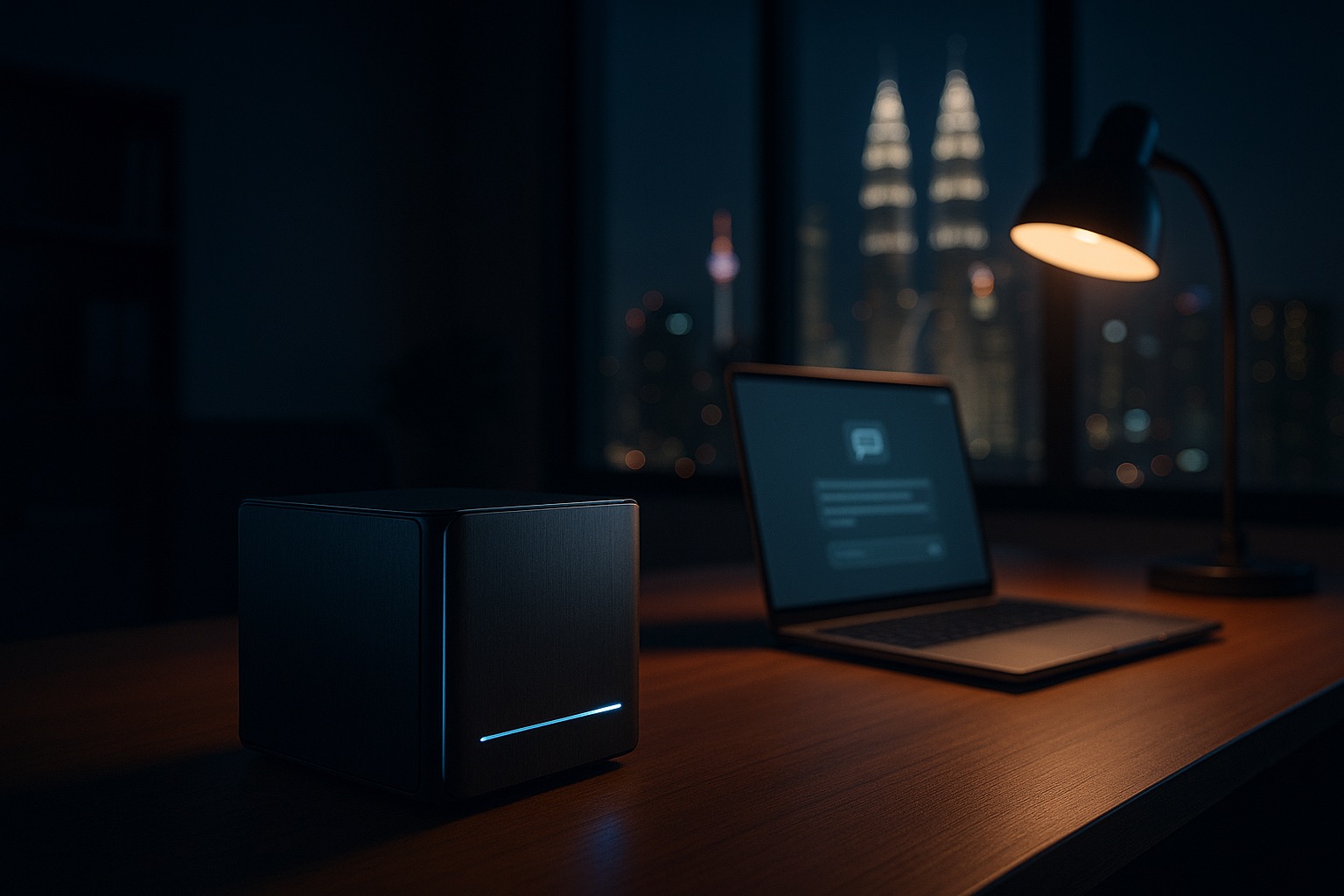
What RTX Spark actually is, in business terms
Strip away the spec sheet and RTX Spark is one idea: NVIDIA put a 20-core CPU, a serious Blackwell GPU, and up to 128GB of unified memory onto a single chip, according to NVIDIA's product page. It is the company's first system-on-a-chip for ordinary Windows laptops and compact desktops.
The number that matters for business AI is the memory. 128GB of unified memory means the machine can hold a genuinely capable AI model entirely in memory and run it at usable speed. Until now, that class of local AI required workstation hardware that looked and sounded like a server. RTX Spark-class machines look like a slightly thick mini PC.
On price, NVIDIA has not announced official figures, but reporting from PCWorld and analyst notes from Computex put entry-level N1 systems somewhere between US$1,799 and US$2,500 depending on configuration, with the higher-end N1X-class machines reaching US$2,899 and beyond. Treat those as pre-launch estimates. Either way, this is premium hardware, not an impulse purchase, and official Malaysian pricing will not be confirmed until closer to the fall 2026 launch.
So that is the offer: a one-time hardware cost, in exchange for AI that runs entirely inside your office. What does that actually buy a Malaysian SME?
What local AI unlocks for a Malaysian business
Your data never leaves the building. This is the headline benefit, and for some businesses it is decisive. When a clinic summarises patient notes, an accounting firm processes client financials, or an agency drafts work from a customer's confidential brief, every cloud AI call sends that data to servers you do not control. Malaysia's Personal Data Protection Act sets real obligations around how personal data is processed and transferred, and the PDPA framework was tightened further with amendments that came into force in 2025, including mandatory breach notification. A model running on a box in your office removes an entire category of that exposure. Our deep dive on private LLMs and enterprise data privacy in Malaysia covers this angle in detail.
The meter stops running. Cloud AI bills scale with usage. Every quotation drafted, every document summarised, every customer email triaged adds tokens to the invoice. A busy SME automating real workflows can comfortably spend RM500 to RM2,000 a month on API usage. Local AI inverts that: heavy daily use costs the same as light use, because you already own the machine.
It works when the internet does not. Less glamorous, still real. A local model responds in milliseconds and keeps working through an ISP outage, which matters more outside the Klang Valley than cloud vendors like to admit.
The practical use cases write themselves: internal document processing, first-draft quotations, summarising supplier contracts, a private knowledge assistant trained on your company's files. Repetitive, high-volume, sensitive — that is local AI's home ground.
The honest cost math
Here is where most coverage gets lazy, so let us be careful.
The local AI side. An RTX Spark-class machine at US$1,799 to US$2,899+ is the visible cost. The invisible costs are real too: electricity for a machine that may run inference all day, the fact that hardware depreciates and the chip you buy in 2026 will be midrange by 2029, and the maintenance reality that someone has to update models, manage the software stack, and fix it when it breaks. Local AI is not free after purchase. It is cheaper at scale, which is a different claim.
The cloud AI side. A light user — a few drafts and summaries a day — might spend RM50 to RM200 a month on API costs. A business running serious automation can reach RM500 to RM2,000 a month and beyond. Over three years, that heavy usage pattern adds up to more than the price of a high-end RTX Spark machine. But a light or spiky usage pattern never does, and the cloud asks for no money up front.
The crossover logic. The break-even question is volume. If your business runs AI hard every working day on tasks a local model handles well, the hardware pays for itself somewhere inside its useful life. If your usage is occasional, bursty, or concentrated in a few complex tasks, cloud economics win indefinitely — you are renting exactly what you use.
There is also a structural difference worth naming: hardware is capex, cloud is opex. Some businesses would rather own an asset; others would rather keep cash and pay monthly. Neither instinct is wrong, but know which one is driving your decision, because vendors on both sides will happily exploit it.
Where cloud AI still wins
This is the part the local-AI excitement skips, and it matters.
Frontier quality. The best models do not fit in 128GB. When the task is complex reasoning — contract comparison, proposal review, multi-step agent workflows — cloud models like Claude remain meaningfully stronger than anything you can run locally. We covered this trade-off from the model side in our guide on whether premium AI models are worth paying for: the expensive failure mode in business AI is not token cost, it is wrong answers that senior staff must catch and fix. A weaker local model that produces more wrong answers can cost far more in review time than it saves in API fees.
No obsolescence risk. Cloud models improve underneath you at no extra charge. A local machine is frozen at whatever its hardware can run; three years in, you own a depreciated box while cloud users quietly upgraded twice.
Multi-user and customer-facing by default. A desktop in your office serves your office. The AI assistant on your website, serving customers at 11pm from KL, Penang, or Singapore, has to live in the cloud — that is not a cost decision, it is an architecture fact.
Scales to zero. Most SMEs' real AI usage is spikier than they think. The cloud charges nothing for the quiet weeks.
The hybrid pattern most SMEs will land on
Put the two lists side by side and the conclusion is not local versus cloud. It is local for some work, cloud for the rest.
The pattern we expect to become standard for Malaysian SMEs within a couple of years looks like this: a local machine handles the sensitive, repetitive, high-volume internal work — document processing, internal drafts, anything touching personal data you would rather keep inside PDPA-friendly walls. The cloud handles frontier reasoning and everything customer-facing — the website assistant, the complex analysis, the workflows where output quality is the whole point. This mirrors what larger enterprises in Singapore and across Southeast Asia already do with private and cloud models; RTX Spark-class hardware simply moves the entry price into SME range. It is also consistent with the direction NVIDIA itself has been signalling for the region, as we noted covering NVIDIA GTC 2026 from a Malaysian business angle.
What should you do between now and the fall launch? Not pre-order on hype. The useful homework is an honest audit of your AI usage pattern: which tasks, how often, how sensitive, and how expensive when wrong. If you have not started that exercise, our AI adoption roadmap for Malaysian SMEs is the structured way in. Businesses that know their usage profile will read the RTX Spark launch pricing and know the answer in five minutes. Businesses that do not will buy on excitement and find out later.
A quick decision checklist
Run your business through these questions:
- Does your AI work touch personal or confidential data daily? Local moves from nice-to-have toward necessary.
- Is your AI usage heavy and daily, or occasional and spiky? Heavy favours local economics; spiky favours cloud.
- Are your highest-value AI tasks complex reasoning or routine processing? Complex reasoning stays in the cloud for quality reasons, whatever the cost math says.
- Do you have anyone who can maintain a local AI stack? If not, factor in a partner or accept the cloud's zero-maintenance advantage.
- Do you need AI in customer-facing channels? That portion lives in the cloud regardless.
- Capex or opex — which suits your cash position this year? Be honest about which instinct is deciding for you.
Mostly "local" answers and a heavy usage pattern? RTX Spark-class hardware deserves a place on your 2026 shortlist. Mostly "cloud" answers? The smartest money stays on cloud AI and skips the shiny box entirely. Mixed answers — which is most Malaysian SMEs — and the hybrid pattern is your destination; the only question is sequencing.
Konsultasi percuma
Not Sure Which Side Your Business Lands On?
We build AI systems both ways — cloud-based assistants and private, on-premise setups. We can help you audit your usage pattern and design the right mix before you spend on either.