

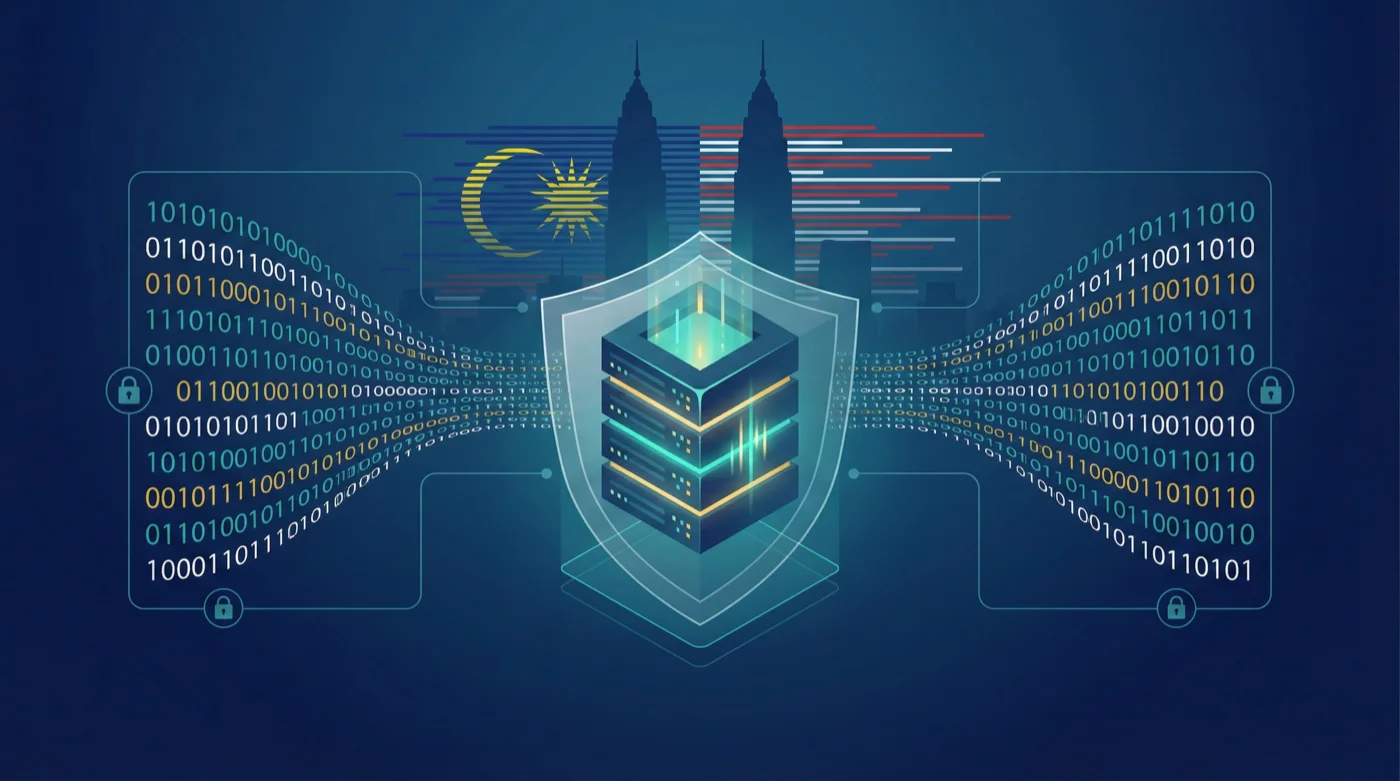
Last month, a Kuala Lumpur financial services firm asked us to review their AI setup. They had been using ChatGPT Enterprise for document analysis—until their compliance officer flagged a concern: customer data was leaving their controlled environment. Even with enterprise agreements, data was being sent to external servers.
This is the core question driving private LLM adoption in Malaysia: where does your data actually go when you use AI?
What is a private LLM?
A private LLM runs within your own infrastructure—on-premises servers, private cloud, or an isolated environment within AWS or Azure. The key differences from public APIs:
- Data stays within your boundary. Prompts and responses never leave your network.
- No external training. Public LLMs may use your inputs to improve their models. Private deployments guarantee this never happens.
- Full audit control. You manage logging, access, and compliance documentation.
Why Malaysian enterprises are paying attention
PDPA 2024 amendments
Malaysia's Personal Data Protection Act underwent significant amendments that took effect through 2025:
- April 2025: Biometric data added to sensitive categories; new cross-border transfer rules
- June 2025: Mandatory DPO for organisations processing 20,000+ data subjects; 72-hour breach notification requirement
Data processors now face direct liability. If your AI vendor mishandles data, your organisation shares the regulatory exposure.
Bank Negara Malaysia's AI governance
BNM published a discussion paper on AI governance at MyFintech Week 2025. Key concern: systemic risk from multiple financial institutions relying on the same external AI providers.
For banks and insurers, private LLM deployment addresses both data sovereignty and reduces dependency on single external providers.
Who actually needs private LLMs?
Good fit
Regulated industries: Financial services under BNM supervision, healthcare with patient data, legal firms with client privilege.
High-volume processing: According to Ptolemay's analysis, private LLM becomes cost-effective when processing over 2 million tokens daily. Most teams see payback within 6-12 months.
Trade secrets: Manufacturing companies with proprietary processes or formulations.
Not necessary
- Low or occasional usage (API pricing works fine)
- Non-sensitive use cases (marketing copy, public content)
- Teams without ML expertise to maintain deployments
- Early experiments where you're still validating use cases
The cost reality
Private LLM costs depend on model size and infrastructure:
- Smaller models (7B-13B parameters): Can run on a single GPU, lower monthly cost
- Larger models (30B-70B parameters): Require multi-GPU clusters, significantly higher investment
Key insight: Hardware is the initial expense, but engineering staff to maintain the system often becomes the largest cost over time.
When it pays off:
- Processing 2M+ tokens daily (per Ptolemay's analysis)
- Strict compliance requirements (PDPA, BNM RMiT)
- High annual API spend where self-hosting reduces per-token cost
Open-source models you can self-host
The open-source LLM ecosystem has matured significantly. Here are practical options based on your hardware:
For single GPU (16-24GB VRAM)
Llama 3.2 3B / Qwen 2.5 7B: Lightweight models suitable for chatbots, FAQ handling, and simple document Q&A. Can run on NVIDIA RTX 4090 or A10.
Mistral 7B: Strong reasoning for its size, Apache 2.0 license. Good for customer service and internal knowledge bases.
For multi-GPU or workstation (48-80GB VRAM)
Llama 3.1 70B / Llama 3.3 70B: Enterprise-grade performance, multilingual support including Bahasa Malaysia. Requires 2x A100 or similar. Free for commercial use under 700M monthly users.
Qwen 2.5 72B: Strong for Asian languages and coding tasks. Good alternative to Llama for Malaysian context.
For on-premises server clusters
Mistral Large / Mixtral 8x22B: Mixture-of-experts architecture, 256K context window. Apache 2.0 license. Designed for privacy-conscious organisations.
DeepSeek V3: Cost-efficient for high-volume inference, strong reasoning capabilities.
Hardware requirements
Chatbot / FAQ (3B-7B models): 16GB VRAM minimum. RTX 4090, Lenovo ThinkPad PGX, or cloud A10.
Document analysis (13B-34B models): 24-48GB VRAM. NVIDIA L40S or A10G.
Enterprise workloads (70B+ models): 80GB+ VRAM. Requires 2x A100 or H100.
Managed private deployments
If you want isolation without managing infrastructure:
AWS Bedrock: Run Llama, Mistral, or Claude within your AWS account. Data stays in your VPC.
Azure OpenAI: GPT-4 with enterprise data isolation. Malaysia region available.
How Anchor Sprint helps
We provide end-to-end private LLM solutions for Malaysian enterprises:
EzyChat for Private LLM
Our EzyChat platform supports both cloud-based and private LLM deployments. For organisations requiring data sovereignty, we can deploy EzyChat with self-hosted open-source models—your customer conversations never leave your infrastructure.
Hardware ecosystem partners
Need on-premises AI infrastructure? We work with hardware partners including Lenovo to provide ready-made AI workstation solutions like the ThinkPad PGX series, purpose-built for local LLM inference. This means you can run private AI without building infrastructure from scratch.
What we deliver
- Assessment: Evaluate whether private LLM fits your compliance and business needs
- Architecture: Design deployment aligned with PDPA and BNM requirements
- Implementation: Deploy and integrate with your existing systems
- Ongoing support: Maintain and optimise your private AI infrastructure
Evaluate Your Private LLM Options
Not sure whether private LLM makes sense for your organisation? We can assess your requirements and design a solution that balances compliance, cost, and capability.
Related: