

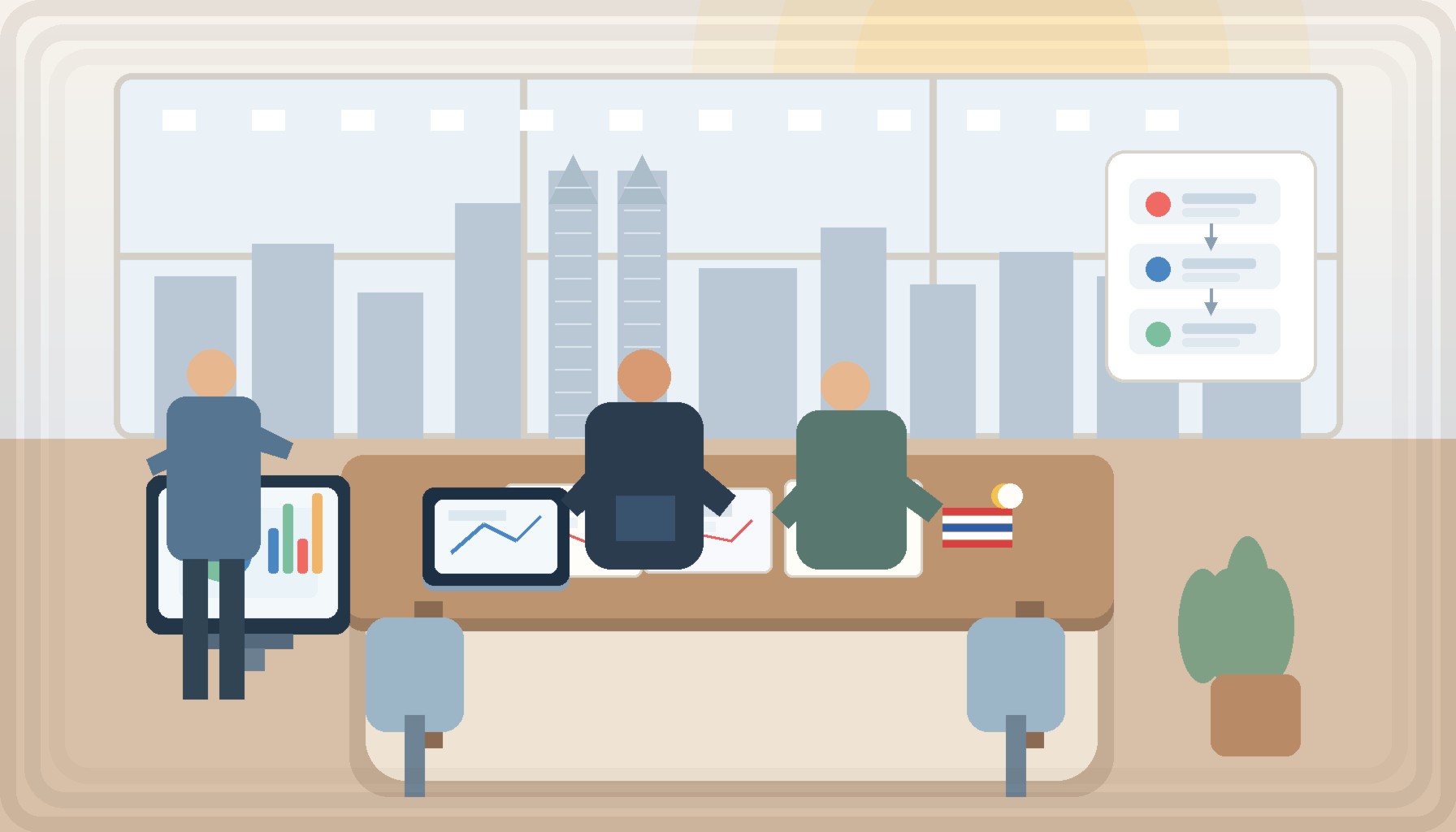
The tax deduction matters most when you pair training with one real workflow your team needs to improve.
It is Friday afternoon in Shah Alam and your finance manager is trying to close two conversations at once. One is about the training budget for the second half of the year. The other is about the same operational headaches your team has been living with for months: leads sitting too long in WhatsApp, staff copying data between systems, and managers still chasing updates that should already be visible in a dashboard.
That is the moment where a lot of Malaysian businesses get AI wrong. They hear about the 50 percent deduction for AI and cybersecurity training, approve a course, and hope the organisation somehow becomes more digital afterwards. Training is useful, but training by itself is not automation.
The more practical reading of Budget 2026 is this: Malaysia has created a better financial excuse to start a focused AI project. MDEC said Belanjawan MADANI 2026 includes RM53 million for the Malaysia Digital Acceleration Grant, RM18 million for the National AI Office, and a 50 percent tax deduction for SME spending on AI and cybersecurity training. MyDIGITAL framed the same deduction as a way to strengthen workforce readiness and business competitiveness in a more AI-driven economy, not as a standalone badge of innovation for its own sake.
If you run an SME, that distinction matters. The opportunity is not to spend less on a workshop. The opportunity is to use the deduction to reduce the cost of building one capability your business can actually deploy.
Start with the workflow, not the course
Most SME teams do not lack ideas about where AI could help. They lack a disciplined way to choose the first use case. In practice, the strongest starting point is usually the workflow that already irritates your staff every week and touches either revenue or service quality.
That could be lead qualification. It could be quotation drafting. It could be support triage, inventory follow-up, or document handling. Whatever the case, you want the training outcome to map directly to that job. If your staff are learning prompt design, data structuring, or automation tooling, they should be applying it to a process that already exists inside your business.
This is where many grant and tax articles stop too early. They list the incentive, maybe mention digitalisation, then leave you alone with a vague instruction to "adopt AI." A better sequence is simpler. First, choose the workflow. Second, decide what capability gap is stopping improvement. Third, train the people who own that workflow. Only then do you start tooling.
If your business is still in the early stages, our AI adoption roadmap for Malaysian SMEs is a good companion read. It helps you separate curiosity from execution.

The best first AI project usually starts with one messy process your team already wants fixed.
Why the deduction matters more in 2026 than it would have a year ago
Malaysia is not just talking about AI in abstract terms anymore. MDEC said generative AI could contribute USD113.4 billion in productive capacity by 2030, and the country is targeting a 30 percent productivity increase through AI-driven solutions. That does not mean every company should rush into an expensive transformation programme. It does mean the surrounding ecosystem is getting more serious.
At the same time, the constraint inside most SMEs is still painfully human. AWS, citing Access Partnership research, said 81 percent of Malaysia's employers struggle to find the AI talent they need. Another AWS SMB study found 37 percent of SMBs say AI skills gaps slow adoption, 47 percent cite data readiness, and 42 percent are frustrated by unpredictable costs.
That combination is exactly why the AI tax deduction Malaysia businesses are talking about is worth attention. It does not solve every execution problem, but it makes it cheaper to close part of the skills gap while you build a clearer implementation path. If you treat the deduction as support for a real operating change, it becomes strategic. If you treat it as a coupon for generic training, it becomes trivia.
What a sensible SME plan looks like
A sensible plan is smaller than most people expect. You do not need an "AI department" to get started. You need one process owner, one measurable problem, and one technical lane that fits your business.
For a services company, that lane may be lead handling. Your team learns how to structure enquiries, create better intake prompts, and connect form or chat data into a CRM. For a distributor, the first lane may be order updates and stock communication. For a professional services firm, it may be proposal drafting and document preparation. The point is to turn training into a working asset.
If you already know that your challenge is broader than one tool, this is where digital transformation planning and AI solutions delivery should meet. Your staff training, workflow redesign, and system integration need to support the same business outcome.
That is also why I would be cautious about buying training in isolation. A course can teach concepts. It cannot clean your pipeline, map your approvals, or connect your inbox to your internal systems. You still need a design step between learning and deployment.
Three decisions to make before you claim anything
Before you spend on training, answer three plain questions.
The first is which workflow should change within 90 days. If you cannot name that workflow, you are still too early.
The second is who will own the outcome after the training ends. If nobody is accountable for implementation, the deduction will subsidise good intentions and not much else.
The third is what system the new workflow needs to connect to. A lot of automation projects fail not because the model is weak, but because the handoff into your real business tools was ignored. Your team may need help from a partner who can support both training and education and the actual delivery work that follows.
Those questions are not glamorous, but they protect you from the most common SME mistake: paying to learn something that never reaches production.

Training creates value when ownership, systems, and rollout timing are clear before day one.
The real lead generation angle for early movers
There is another reason this matters. SMEs that use the deduction well tend to improve customer-facing speed as well as internal efficiency. The first useful automation often shows up in enquiries, response times, quotation turnaround, and follow-up quality. That becomes visible to customers very quickly.
If your website is already bringing in traffic, the next layer is making sure the business behind that site can respond faster and more consistently. That is why articles like our guide to AI search after Google I/O 2026 and our overview of practical AI use cases for Malaysian SMEs connect so naturally to this topic. Better visibility is useful. Better operations are what turn visibility into revenue.
The businesses that benefit most from this incentive will not be the ones that collect the most certificates. They will be the ones that use training to redesign one awkward process, prove value, and build from there. That is a much more believable story for your finance team, your operations lead, and your customers.
Malaysia has made the entry point a little cheaper. Now the real question is whether you will spend that room on theory, or on a workflow your business can actually improve this quarter.
Free consultation
Turn Your AI Training Budget Into a Working Automation Plan
If you want to use Malaysia's AI tax deduction on a real workflow, we can help you pick the right use case, train the team, and implement the system behind it.