

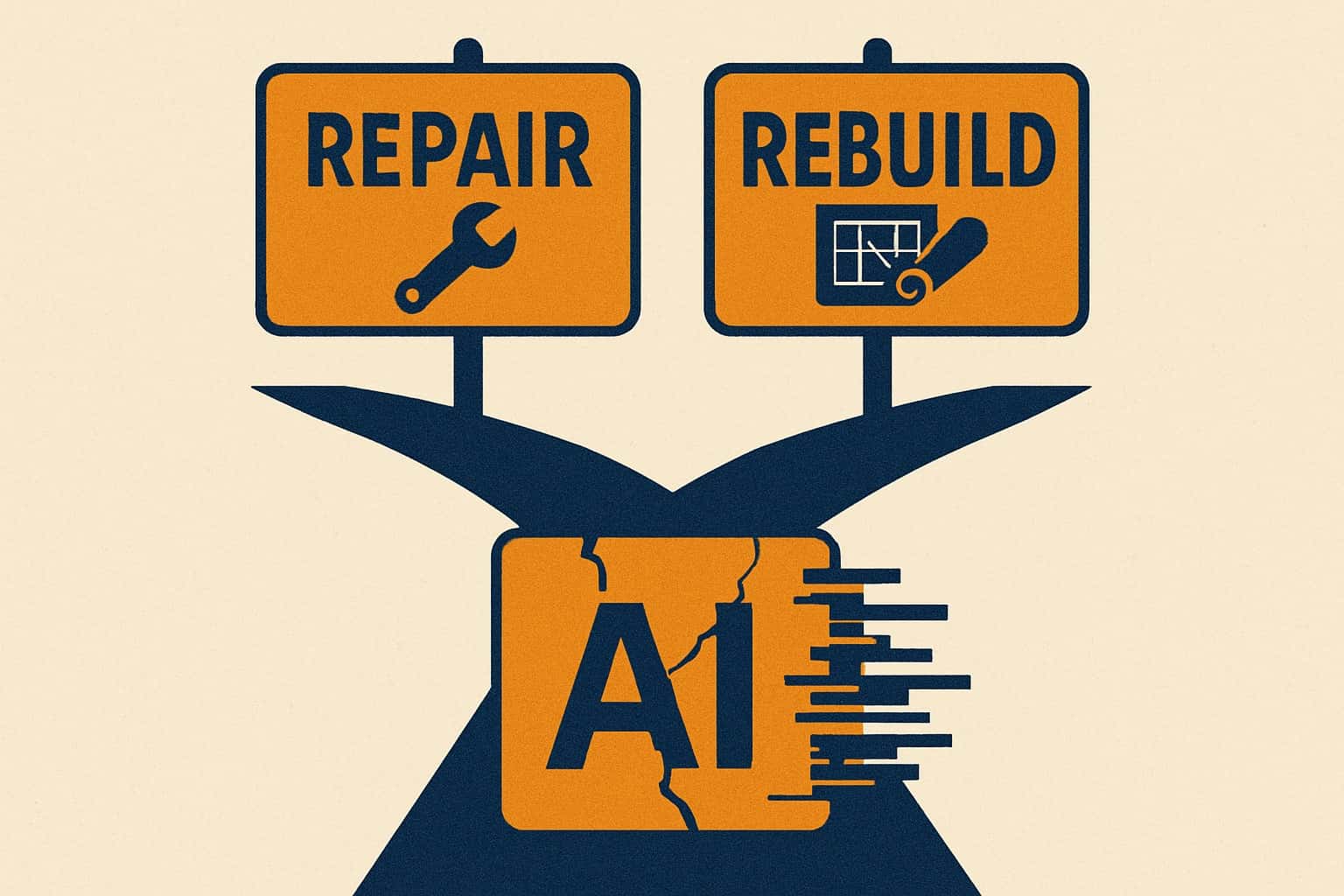
A broken AI agent isn't always a write-off — but you need an honest read before you spend another Ringgit on it.
A KL logistics company paid a vendor a five-figure sum for an AI agent to handle order enquiries. In the demo it was flawless. Three months into production it was quietly making things up — quoting delivery dates it had no way to know, occasionally emailing customers the wrong address, and failing on anything that wasn't a textbook order. The vendor had gone quiet. The operations lead was stuck with something that looked like an AI agent but couldn't be trusted with a real customer.
If some version of that is happening to you, the first question isn't "who do I blame" — it's "can this be fixed, or do I have to start again?" This is a field guide to answering it, and to knowing when a fix to your AI agent is worth it and when it isn't.
Why agents fail after the demo
The uncomfortable truth is that a demo proves almost nothing. Demos run on happy-path inputs the builder chose. Production runs on whatever your customers actually type, at 2am, in three languages, with edge cases nobody scripted. The gap between those two is where most agent projects quietly die. The failure modes are remarkably consistent:
- Confidently wrong. The agent answers everything — including things it has no basis to answer. Without guardrails and grounding, a language model will invent a plausible delivery date or policy rather than say "I don't know."
- Never evaluated. There's no test suite, no golden set of real cases, no measure of how often it's right. Nobody can actually tell you its accuracy, because nobody measured it.
- Brittle integration. It half-connects to your systems. It reads, but writes fail silently; a retry creates a duplicate order; an API change breaks it and no one notices for a week.
- No documentation, no owner. The prompts, the logic and the "why" live in one freelancer's head. When they move on, so does any hope of maintaining it.
- Runaway cost. It's wired to the most expensive model for every task, or it loops, and the token bill balloons for work a cheaper setup would do fine.
None of these are exotic. They're the predictable result of building an agent as a one-off deliverable instead of a governed system — which is exactly why Anthropic's own guidance stresses starting simple, adding tools deliberately, and measuring (Anthropic — Building effective agents). Most failed agents skipped the measuring.
The rectify-or-rebuild decision
Here's the framework we use when someone hands us a broken agent. It comes down to one question: is the foundation sound, or is the foundation the problem?
Lean toward rectify when:
- The core approach is reasonable — the right task, a sane model choice, real access to your systems — but it's missing guardrails, evals, or error handling.
- The code and prompts are legible enough to understand and extend.
- The failures are specific and reproducible (it breaks on X), not diffuse ("it's just unreliable").
Lean toward rebuild when:
- There's no separation between "read" and "write" actions, no logging, and no way to reconstruct what it did — you can't safely change what you can't see.
- The whole thing is a thin wrapper around a single mega-prompt with no structure, so every fix breaks something else.
- It's fundamentally aimed at the wrong problem, or the "agent" is really a chatbot that was never going to complete the task.
The honest answer is sometimes that a rebuild is cheaper than a rescue — patching a broken foundation costs more over a year than replacing it. A good partner will tell you that up front rather than bill you to prop up something that won't hold. That honesty is the whole point of a proper audit.
The same two questions apply when the thing that broke isn't an agent but the application itself — a web app or internal tool assembled quickly with an AI assistant, working in the demo and failing in production. We run that as Vibe Code Rescue: the same audit first, then a fix measured against criteria agreed in writing before anyone touches the code.
What a real quality bar looks like
Whether you rectify or rebuild, the destination is the same: an agent that would pass the bar it should have been held to in the first place. Concretely:
- It's measured. Scored against a golden set of your real cases — we use the Agent GPA framework (Goal, Plan, Action) — so its accuracy is a number, not a vibe. It doesn't go live until it beats your manual baseline.
- A human stays in the loop on anything that matters. The agent evidences and drafts; a person approves the decisions with consequences.
- It's grounded and guarded. It works from your real data, resists prompt injection, and is honest when it doesn't know — rather than inventing an answer.
- It's observable and safe. Every action is logged and reversible-by-design; a retry can't create a duplicate; failures route to a human, not into a void.
- Data is handled properly — PDPA/PDPC-aligned, least-privilege access to your systems.
That's not gold-plating. It's the difference between a demo and something you can put in front of a customer. We wrote up how we build to that standard, use case by use case, in our AI agent use-case directory.
What it costs to find out
The good news: finding out where you stand is cheap. A proper AI agent audit — someone experienced going through the agent, its integration, and its (missing) evals and giving you a plain rectify-or-rebuild verdict — is the highest-leverage RM you can spend, because it stops you pouring money into either a doomed patch job or an unnecessary rebuild.
We offer that audit free, precisely because the verdict should be honest and not shaped by a quote. If a rescue makes sense, our handover runs RM 2,000–5,000 in Malaysia (S$1,000–3,000 in Singapore) to take ownership and stabilise the agent — priced to how much is broken — with ongoing maintenance scoped to its real load. If a rebuild is the right call, we'll tell you that instead — and you can see what building an AI agent properly involves.
The one thing not to do is keep paying to keep a broken agent limping along in front of real customers. Every confidently-wrong answer it gives is a customer you're quietly losing.
Frequently asked questions
My AI vendor delivered an agent that doesn't work — what can I do?
Start with an honest audit before spending anything more. A proper assessment tells you which of three you're in: the agent is fixable as-is, it's fixable but needs an ongoing monthly maintenance retainer to hold up under real load, or it's better rebuilt from a sound foundation. Anchor Sprint offers that audit free for businesses in Malaysia and Singapore.
Can a broken AI agent be fixed, or do we have to rebuild it?
Often it can be fixed — if the core approach is sound and it's just missing guardrails, evals or error handling. A rebuild is better when there's no separation between read and write actions, no logging, or the whole thing is a single mega-prompt with no structure. The audit gives you a clear rectify-or-rebuild verdict with the reasoning.
How much does it cost to fix an AI agent in Malaysia or Singapore?
The audit is free. If a rescue makes sense, handover is a one-off RM 2,000–5,000 in Malaysia (S$1,000–3,000 in Singapore) depending on how much is broken, plus — only if the audit shows it's needed — an ongoing monthly maintenance retainer scoped to the agent's load.
How do I know if my AI agent is actually working?
A working agent is measured (scored against real cases with a framework like Agent GPA, and beating a human baseline before go-live), reliable on edge cases, safe and grounded rather than confidently wrong, and observable — every action logged. If none of that exists, that's the red flag.
How long does an AI agent audit take?
We aim to come back with an honest read within one business day of receiving your details — access to the agent or a demo, what it's meant to do, and any code, prompts or reports you have.
An agent that holds credentials is also an exposure surface — Anthropic's September 2026 threat report lists victim-deployed AI agents among the places attackers now mine for access tokens.
免费咨询
Stuck with an AI agent that doesn't work?
Send us what your vendor built and what's going wrong. We'll give you an honest, free audit — rectify or rebuild — usually within one business day.
See how AI Agent Rescue works (free audit → handover → maintenance)
Explore our AI agent development services
Browse the AI agent use-case directory
Sources
- Anthropic — Building effective agents: why agents should start simple, add tools deliberately, and be measured.
This article is general guidance, not a warranty — get a proper assessment of your specific agent before deciding to rectify or rebuild.