

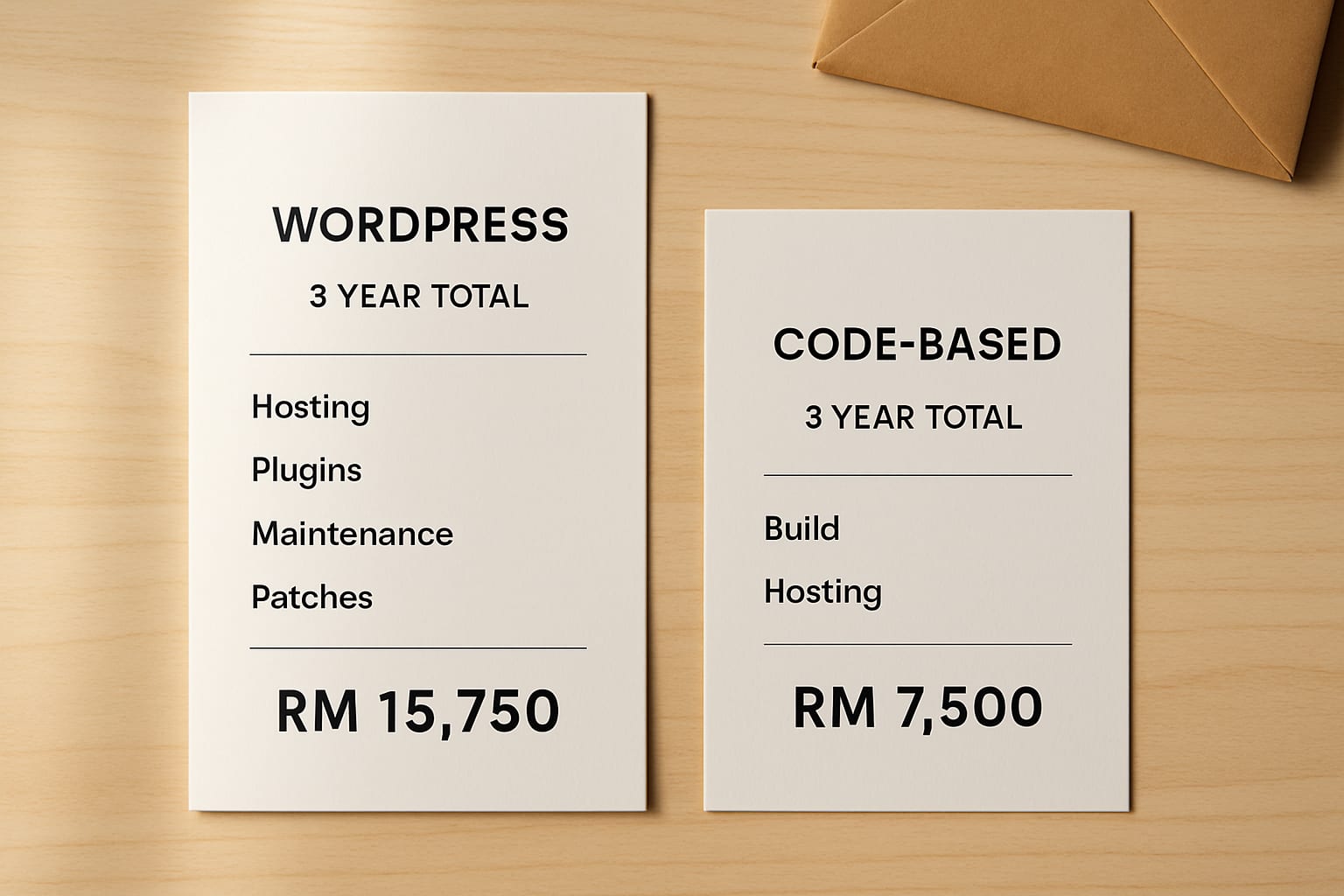
The web design Malaysia price shown on a quotation rarely tells you what the website will actually cost. Most Malaysian SMEs see two quotes side by side — three thousand ringgit for a WordPress site, five thousand ringgit for a custom-coded site — and pick the cheaper one. On Year 1 paper, it looks rational.
Three years later, the WordPress site has cost roughly fifteen to eighteen thousand ringgit in plugin renewals, hosting upgrades, security patches, and broken-update fixes. The code-based site has cost about seven to eight thousand ringgit over the same period.
The salesperson who pitched the cheaper quote never showed you those numbers. Most do not run the three-year math. This guide compares the web design price Malaysia buyers see at launch with the full cost of ownership, plugin by plugin and year by year.
Quick Answer: Website Design Prices in Malaysia
For a professional Malaysian SME website, the initial build commonly ranges from RM 1,800 to RM 8,000. The more important comparison is the three-year total: platform subscriptions, plugins, hosting, maintenance, ownership, and the cost of switching providers.
If you are comparing a website design price in Malaysia, request both the launch price and the estimated three-year operating cost. A lower build quote can become the more expensive option when recurring software and maintenance charges are included.
The Web Design Malaysia Pricing Landscape
Before the comparison, a quick orientation. Web design quotes in Malaysia in 2026 land in four broad tiers:
- The floor (RM 800 – RM 1,500) — template-based, often BM-targeted budget vendors. Fast turnaround, generic outcome.
- The SME mid-range (RM 1,800 – RM 5,000) — where most reputable agencies sit, including Anchor Sprint's Starter, Business, and Professional packages. Custom design, modern stack, real warranty.
- The premium custom range (RM 8,000 – RM 20,000) — agencies positioned on bespoke design and longer sales cycles. Often justified, sometimes margin.
- Enterprise (RM 25,000+) — multi-stakeholder builds with complex integrations or e-commerce platforms.
The interesting question isn't which tier should you pick — that depends on your business stage. The interesting question is what you actually pay over three years, because that's when the build-cost-versus-platform-cost split becomes the dominant number.
For a deeper breakdown of what each tier actually buys, see our full pricing guide for Malaysian SME websites.
The 3-Year Cost Reality: WordPress vs Code-Based
This is the comparison most pricing pages skip. Both sites in this example are 5-page SME business websites with a contact form, WhatsApp button, blog, and basic SEO setup — the kind of build the majority of Malaysian SMEs actually need.
Year 1: Build + Setup
WordPress site:
- Build cost: RM 3,000
- Premium hosting (after the free first year ends mid-year): RM 600
- Premium plugins (forms like Gravity, SEO like Yoast Premium, security like Wordfence Premium, speed like WP Rocket, backups like UpdraftPlus): RM 1,500
- Premium theme licence: RM 250
- Year 1 subtotal: ~RM 5,350
Code-based site:
- Build cost: RM 5,000
- Managed hosting (Cloudflare Pages, Vercel, or similar — not free, but lighter): RM 200
- Premium features (forms, SEO, security): RM 0 (built into the stack)
- Year 1 subtotal: ~RM 5,200
So far, almost dead even. The custom site looks more expensive on the quote, but once Year 1 plugin renewals are tallied, WordPress is already slightly ahead in cost.
Year 2: Where the Gap Opens
WordPress site:
- Hosting renewal: RM 600
- Plugin renewal subscriptions: RM 1,500
- "Why is my site slow?" hosting upgrade to a higher tier: RM 400
- Maintenance retainer or per-incident fixes (averaging two hundred ringgit per month): RM 2,400
- Year 2 subtotal: ~RM 4,900
Code-based site:
- Hosting renewal: RM 200
- Per-request maintenance (typically three requests in a year at three hundred ringgit each): RM 900
- Year 2 subtotal: ~RM 1,100
By the end of Year 2, the WordPress site is already nearly four thousand ringgit ahead on running costs — and nothing has gone wrong yet.
Year 3: Cumulative Total
WordPress site:
- Hosting + plugin renewals + maintenance: ~RM 4,500
- One inevitable plugin-conflict emergency (broken update, payment gateway issue, or theme incompatibility after a major WP version): ~RM 1,000
- Year 3 subtotal: ~RM 5,500
Code-based site:
- Hosting + per-request maintenance + minor content updates: ~RM 1,200
- Year 3 subtotal: ~RM 1,200
The Three-Year Picture
- WordPress 3-year total: approximately RM 15,750
- Code-based 3-year total: approximately RM 7,500
The WordPress site costs roughly twice as much as the code-based site over three years — and that's the conservative estimate. Sites that grow past 20 plugins, or that need a custom integration mid-cycle, regularly cross twenty thousand ringgit cumulative by Year 3.
A note on honesty: code-based hosting isn't free. Cloudflare Pages, Vercel, and similar platforms still bill management fees of roughly two hundred to six hundred ringgit per year for SME-tier sites. The savings come from removing the plugin tax and the hosting-upgrade trap, not from "free hosting."
Where WordPress's Hidden Costs Actually Come From
The Year 2 and Year 3 numbers above aren't padded. They reflect four real mechanisms that show up on almost every Malaysian WordPress site we audit.
The plugin tax. WordPress's "free" plugin ecosystem is largely a loss-leader for paid tiers. The forms plugin you need at scale (Gravity Forms or WPForms Pro). The SEO plugin everyone defaults to (Yoast Premium). The speed plugin that gets you a usable mobile score (WP Rocket). The security plugin that handles bot traffic (Wordfence Premium). Each of these runs two hundred fifty to five hundred ringgit per year. They add up faster than most quotes acknowledge.
The hosting upgrade trap. Shared hosting from local providers like Shinjiru works for the first three months. Once your WordPress site is running twenty-plus plugins, page speed drops. The hosting provider's solution is always the same: upgrade to "Cloud Boost," "Premium VPS," or "Managed WordPress" at two to three times the original price.
Plugin conflict maintenance. When dozens of plugins from different developers ship updates on different schedules, something breaks every four to six weeks. Either your team loses a Saturday troubleshooting it, or your agency charges two hundred to five hundred ringgit per incident.
Agency lock-in. Your developer customised your theme to make it work. Now switching agencies means partially rebuilding the site, because the customisation isn't portable. Effective switching cost: two thousand to five thousand ringgit. This rarely appears on any quote, but it's the cost of the choice — not just the cost of the build.
If any of this resonates, our piece on the five signs your business has outgrown WordPress walks through the specific thresholds where these costs start hurting.
When WordPress Still Makes Sense
A pricing comparison that doesn't admit the exceptions isn't credible. WordPress remains the right answer in four specific situations:
- E-commerce with one thousand or more SKUs. WooCommerce's ecosystem of payment gateways, shipping integrations, and inventory tools is genuinely mature. Building this from scratch in a code-based stack is rarely worth it.
- Content teams of five or more editors with established publishing workflows. WordPress's admin interface is what those workflows are built around. Switching costs are high.
- Membership and community sites with role-based access control. Tools like BuddyPress, MemberPress, and LearnDash handle this natively. Code-based alternatives exist but require more custom work.
- Sites where the business owner must edit HTML or rearrange page widgets daily. Page builders like Elementor and Divi exist for this reason. If you genuinely need that level of granular self-service editing, WordPress earns its plugin tax.
For most Malaysian SMEs — service businesses, F&B, clinics, professional services, consultancies — none of these conditions apply. Those businesses publish a handful of pages and update content occasionally. They're exactly where the WordPress maintenance overhead delivers no proportional value.
What This Means for Anchor Sprint Pricing
If the 3-year math matters to you, here's how our packages map against the comparison above:
- Starter package — RM 1,800: replaces a typical RM 3,000–4,000 WordPress build, saving approximately eight thousand ringgit over three years in running costs.
- Business package — RM 3,000: replaces a typical RM 6,000–8,000 WordPress build, saving approximately ten thousand ringgit over three years.
- Professional package — RM 5,000: replaces a typical RM 10,000+ WordPress build with CMS, saving approximately fifteen thousand ringgit over three years.
Hosting runs six hundred ringgit per year managed (not free — honest pricing). Maintenance is three hundred ringgit per request, not a monthly retainer — you only pay when you actually need help.
That structure is deliberate. Code-based sites don't need the constant patching that WordPress sites do, so charging a monthly retainer for maintenance that mostly isn't needed wastes your money. We charge per request because that's what aligns our pricing with what the technology actually requires.
For the deeper view on what code-based stacks unlock beyond cost savings — AI integration, edge hosting, structured data control, headless content swaps — see our companion piece on WordPress vs custom development trade-offs for Malaysian SMEs. If you're already past the decision and want the migration path, the WordPress-to-static migration guide walks through it.
免费咨询
Want a 3-year cost breakdown for your specific site?
Send us your current quote (or your current hosting bill) and we'll run the same math against an 安克极速 package. No sales pitch, just the numbers — so you can decide what's actually cheaper over three years for your business.
Explore Anchor Sprint Website Packages